Best Remote Control for DSLR: Top Wireless Shutter Remotes for Your Camera
Looking for a reliable remote to minimize camera shake and time your shots precisely? This guide highlights five versatile DSLR remote controls that work across major brands. The selections are best for: action shooters who need quick shutter control, long-exposure photographers who require timer features, and studio photographers who benefit from stable, repeatable shots. Compare compatibility, range, and key limitations to choose the right remote for your setup.
| Product | Brand | Why It Stands Out |
|---|---|---|
| AODELAN Remote Control | AODELAN | Broad Canon compatibility, plus other major brands; ideal for mixed gear. |
| CamKix Infrared Remote | CamKix | Simple IR option with reliable range; good for entry-level setups. |
| PIXEL 2.4G Remote | PIXEL | Longer-range 2.4 GHz wireless with flexible shooting modes. |
| PROfezzion Nikon/DSLR Remote | PROfezzion | Wide compatibility and 2.4 GHz reliability; strong for Nikon and other bodies. |
| NEEWER Timer Remote | NEEWER | Advanced timer and interval features for time-lapse and long exposures. |
AODELAN Camera Remote Control

The AODELAN remote supports Canon EOS RP and a broad list of Canon bodies, plus Fujifilm X-T3. It functions as a wireless shutter trigger and also as a wired shutter receiver if needed, with batteries required for both transmitter and receiver. This model is best for photographers who work with multiple Canon bodies or in mixed camera setups. A note: ensure you have the correct battery types installed as specified by the package.
Best for: photographers with Canon systems seeking broad compatibility and a mix of wireless and wired triggering options. Limitations: requires two AAA batteries for the receiver and a CR2032 for the transmitter; check battery availability before a shoot.
Foto&Tech FTML-L3 Wireless Remote

Foto&Tech FTML-L3 offers wireless remote control compatibility with multiple Nikon models and some Canon cameras. It’s a straightforward option for photographers who require a reliable IR remote within a moderate range (up to roughly 16 feet). This is a good fit for portrait sessions and small studios where line-of-sight is practical.
Best for: Nikon shooters seeking a reliable IR-based solution without complex setup. Limitation: line-of-sight requirement means obstructions can disrupt the signal; not ideal for busy outdoor action where angles change frequently.
CamKix Wireless IR Shutter Remote

CamKix provides an infrared wireless shutter remote compatible with select Nikon and Canon cameras, supporting quick-response, delayed, and bulb modes. The range is up to about 16 feet with line-of-sight. It’s a practical option for beginners or hobbyists who want a simple, plug-and-play solution without extra features.
Best for: casual shooters who want a basic, easy-to-use wireless shutter. Caution: depends on clear line-of-sight; obstructions can reduce reliability in outdoor environments.
PIXEL 2.4G Wireless Remote

The PIXEL 2.4G remote supports Nikon cameras with a long range and multiple shooting modes, including single, continuous, high-speed, bulb, and 4S delay. It enables shutter triggering up to 100 meters away in some configurations and provides flexible compatibility across several Nikon bodies and Olympus/Pentax options. The device uses 2.4 GHz wireless technology to minimize interference.
Best for: shooters who need a longer-range, flexible control for Nikon or mixed rigs. Limitation: several camera brands listed may require careful compatibility checks before purchasing.
PROfezzion Wireless Shutter Remote (Nikon/Z Series)

PROfezzion’s remote control is designed for Nikon Z6, Z7 series and multiple DSLR bodies, with a 2.4 GHz link and up to 50 meters of range when connected to the camera. It includes a transmitter, receiver, and connecting cable, and uses AAA batteries. This model is well-suited for studio and field work with Nikon mirrorless and DSLR bodies.
Best for: Nikon Z series users and other compatible DSLR bodies who want reliable wireless triggering with a multi-part kit. Caution: not all Nikon bodies may support every feature; verify compatibility for advanced modes with your exact model.
NEEWER Digital Timer Remote
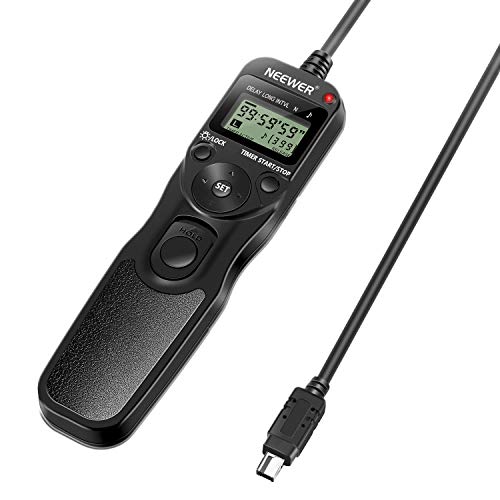
NEEWER’s timer remote adds a delay and interval timer, long exposure timer, and exposure count control. It enables autofocus with a half-press and trigger with a full press. It supports interval shooting and can operate for extended sequences, making it suitable for time-lapse projects or long exposures in astrophotography and scenery.
Best for: photographers needing precise interval or long-exposure control. Limitation: more complex interface may require a quick setup read-through for first-time users.
Buying Guide: Practical Purchase Considerations
- What shooting style will you use the remote for? Decide between stills, long exposure, time-lapse, or action bursts to pick the right feature set.
- What brand ecosystem do you use? If you shoot across Canon, Nikon, Fujifilm, and others, choose a model with wide brand compatibility or consider multiple remotes for different systems.
- Range and line-of-sight: IR remotes require direct visibility, while 2.4 GHz wireless options offer longer ranges and less obstruction sensitivity.
- Power and battery type: confirm whether the transmitter and receiver require AAA or coin-cell batteries, and whether those are included or sold separately.
- Mode variety: for studio work, you may want quick-shot, delayed, bulb, and interval modes. For field work, consider weather resistance and ease of use with gloves.
- Ease of setup: easier remotes are ideal for beginners, while feature-rich options suit advanced shooters needing precise timing and automation.
FAQ
- Do I need a remote for every camera brand? Not necessarily. If you own multiple brands, a single universal remote with broad compatibility can simplify gear, but some brands require specific remotes for full feature support.
- What is the typical range for wireless remotes? Infrared (IR) remotes usually have a range of about 5-16 feet, with line-of-sight. 2.4 GHz wireless remotes can reach farther, often 30-100 feet or more depending on model.
- Can a remote be used for long-exposure photography? Yes, many remotes include bulb or timer modes ideal for long exposures and astrophotography.
- Are batteries included in most remotes? Some packages include batteries for the transmitter and/or receiver, but not always. Check the product listing before purchase.
- Is a wired remote better than wireless? Wired remotes eliminate wireless interference and signal dropouts, but wireless remotes provide more flexibility for different shooting angles.
- What should I check before buying? Confirm camera compatibility with your exact model, confirm range needs, and verify whether you need interval/timer features for your projects.