Best Ways to Convert a Camera to an IP Camera
Answering the common buyer question: you can turn many analog or coax-based cameras into IP-enabled devices using purpose-built adapters and encoders. This guide highlights five strong options, each suited to different installation scenarios—from small home setups to larger surveillance upgrades. The top picks emphasize ease of use, compatibility with NVRs, and minimal rewiring. Ideal buyers include property managers upgrading existing CCTV, homeowners expanding remote access, and small businesses seeking cost-effective IP conversion.
| Product | Best For | Key Advantage |
|---|---|---|
| DIYSecuritycameraworld IPConverter Self-Adaption | Small to mid-size NVR setups | Automatic adaptation for 1080P BNC cameras |
| CubQuantnestars POE Over Coax Converter | Long-distance upgrades over existing coax | Dual-medium POE over coax and twisted pair |
| MEIRIYFA Passive Video Balun | Budget-friendly analog-to-IP upgrades | Simple BNC to RJ45 with power passthrough |
| LQY0T AHD2NET Encoder | Multi-format analog cameras to IP | ONVIF/RTSP/RTMP compatibility |
| Cunyuer Network Coaxial Transmitter | Coax-based IP extension | Passive, no power required |
Below you’ll find five product sections with direct links, image references, and practical buyer guidance. Each section explains who benefits most, why the option was chosen, and a small caution where relevant. A buying guide and FAQ follow to help compare features and make a confident decision.
DIYSecuritycameraworld IPConverter Self-Adaption

Best for: Small NVR setups needing a simple bridge from 1080P BNC cameras to IP networks. This converter adapts 1080P AHD/CVI/TVI cameras to IPC format, enabling integration with most standard NVRs. It’s a straightforward choice when upgrading a limited number of cameras without large-scale rewiring. Caution: It requires a DC12V 1A power supply, which is not included.
CubQuantnestars POE Over Coax Converter
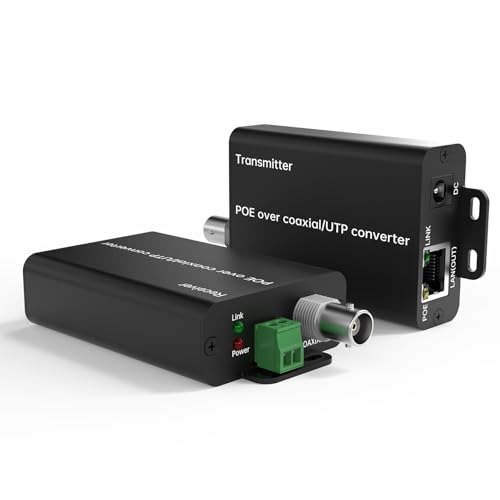
Best for: Upgrading long-distance analog CCTV installations where rewiring is impractical. This device enables POE power and data over coaxial (BNC) and also supports twisted pair. It’s particularly effective for elevator carts, large facilities, or outdoor setups with existing coax lines. Caution: Ensure compatibility with your PoE switches and confirm the maximum supported distances for your camera models.
MEIRIYFA Passive Video Balun

Best for: Budget-conscious upgrades where the goal is to extend IP capability over standard UTP cables. The balun pairs work with CVI/TVI/CVBS and AHD signals, making it suitable for a broad range of cameras. Caution: It does not handle power delivery by itself; plan for separate low-voltage power where needed.
LQY0T AHD2NET Encoder

Best for: Upgrading diverse analog cameras (AHD/TVI/CVI/CVBS) to IP with broad compatibility. It supports ONVIF/RTSP/RTMP and multiple streaming protocols, making it a strong choice for mixed-camera environments. Caution: Basic configuration details like IP address defaults require careful setup to avoid access issues on networks.
Cunyuer Network Coaxial Transmitter

Best for: Passive IP extension over coax with minimal wiring changes where power is not readily available at the camera location. This device delivers real-time digital signal transmission over coax with practical range. Caution: It is a passive device and has no built-in power; ensure your installation environment can supply PoE if needed elsewhere in the chain.
CubQuantnestars 4-Pack POE Over Coax Kit

Best for: Larger upgrades requiring multiple channels, with consistent POE power and data transmission over coax and twisted pair. This kit is suited for multi-camera deployments in warehouses or campuses. Caution: Like other EOC solutions, verify compatibility with existing cameras and network gear before purchasing in bulk.
Buying Guide
What should you consider when converting cameras to IP?
- Compatibility: Ensure the converter or encoder supports your camera formats (AHD/TVI/CVI/CVBS) and desired IP standards (ONVIF, RTSP).
- Power needs: Some devices require a separate power supply; others use PoE. Plan accordingly for the location and power availability.
- Distance and cabling: Coax-based solutions excel where coax runs exist; assess maximum transmission distances and whether additional media adapters are needed.
- Network integration: Confirm compatibility with your NVR, VMS, and security software. Default IPs and login credentials should be documented for quick setup.
- Scalability: If you plan to upgrade multiple cameras, consider multi-pack kits or products that minimize the need for adapters and extra wiring.
FAQ
- Are these devices plug-and-play? Some are easy to install with minimal setup, while others require standard network configuration and IP management.
- Do I need to replace cameras completely? Not necessarily; many options convert existing analog cameras to IP-friendly formats.
- Will all cameras be compatible with ONVIF? Most modern encoders support ONVIF, RTSP, and RTMP; always verify with your NVR.
- Can I extend an IP system over coax without power? Passive devices work without power, but active PoE options require a power source or PoE.
- What’s the best choice for a large facility? Multi-pack or dual-medium options that support both coax and twisted pair can simplify deployment and maintenance.