Best Video Monitor for DSLR: Top 5 External Helps for Clearer Shots
Answering: If you need a reliable external monitor for DSLR work, these five models provide bright displays, accurate color, and useful tools that help you frame, focus, and expose correctly in varied conditions. The best choice depends on brightness needs, portability, and feature depth. This guide targets creators using DSLRs for video who want professional-level monitoring without complexity. The following picks cover high brightness, robust focus tools, and easy rig integration for handheld, on-gimbal, or studio shoots.
| Product | Brand | Why It Stands Out |
|---|---|---|
| NEEWER F700 7″ Field Monitor | NEEWER | Very bright 2000 nits; 4K HDMI loop in/out; extensive LUT and waveform tools |
| FEELWORLD FW759 | FEELWORLD | Slim, lightweight 7″ with 1280×800 IPS; solid focus/exposure tools; good value |
| FEELWORLD FW759PRO | FEELWORLD | 7″ 1280×800; touch; reliable outdoor visibility; strong 4K HDMI support |
| FEELWORLD S55 V3 | FEELWORLD | 6″ compact with waveform, vectorscope, LUT, and robust focus tools |
| FEELWORLD F5 Prox | FEELWORLD | 5.5″ high-brightness monitor with 1600 nits and 3D LUT; portable on the go |
NEEWER F700 7″ Field Monitor

The NEEWER F700 is a 7-inch HDR field monitor with a 1920×1080 IPS screen and 2000 nit brightness. It includes 3D LUTs, peak focus features, and a detailed waveform/vectorscope suite. It supports 4K HDMI loop in/out and a 3.5mm headphone jack for audio monitoring, making it suitable for professional DSLR and mirrorless shoots that require precise exposure and focus checks. Best for high-brightness outdoor shoots and studios where a bright, feature-rich monitor is essential.
Best for: videographers who need peak brightness and a comprehensive toolset in one package. Limitations: larger rigs may require more mounting options, and some users may want more battery options beyond NP-F750s.
FEELWORLD FW759
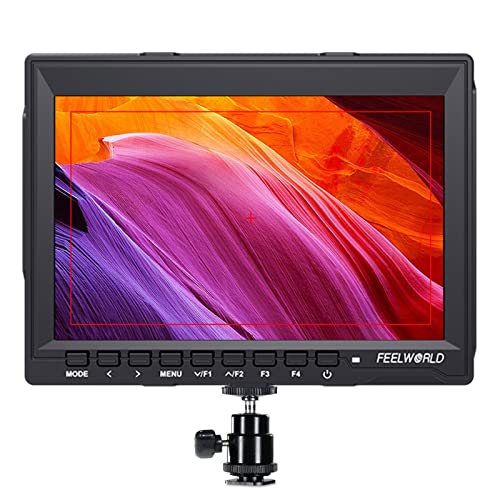
The FEELWORLD FW759 offers a 7″ IPS display at 1280×800 with a slim profile and 4K HDMI input. Its light weight (about 300 g) and ultra-slim design make it well-suited for gimbals and stabilizers. It provides critical tools for on-camera monitoring, such as focus peaking, histogram, and exposure warnings. Best for: on-the-go shooters who need a portable, reliable monitor without adding bulk. Limitation: brightness is mid-range (around 400 cd/m2), which can impact outdoor visibility in bright sun.
FEELWORLD FW759 Pro (Second FW759 Variant)

This FW759 Pro variant provides a similar 7″ viewing experience with focus tools, LUT potential, and a reliable 4K HDMI input. It complements DSLR setups where crisp framing and exposure accuracy are required, while staying light enough for handheld rigs. Best for: indoor studios or on-the-go shoots where a balanced feature set and portability matter most. Caution: some users may prefer higher brightness for direct sun conditions.
FEELWORLD S55 V3

The FEELWORLD S55 V3 is a compact 6″ monitor with a 1920×1080 IPS panel and 450 nit brightness. It includes waveform, vectorscope, RGB histogram, focus assist, and 3D LUT support for on-camera exposure and color decisions. Best for: studios and indoor productions where a smaller, budget-friendly external monitor is preferred. Limitation: smaller screen may not provide as much room for critical focus checks in dynamic shots.
FEELWORLD F5 Prox

The FEELWORLD F5 Prox delivers a 5.5″ high-brightness display at 1600 nit with a 3D LUT workflow and waveform tools. It’s designed to replace smaller built-in screens and enhance outdoor visibility. Best for: creators who need a compact, bright monitor with LUT previews for Log shooting while on location. Caution: smaller screen size may compromise framing checks for groups or complex scenes.
Buying Guide: Key Considerations For Choosing A DSLR Video Monitor
- Brightness and outdoor visibility: If you shoot outside often, prioritize models offering 1000+ nits like the NEEWER F700. For indoor studios, 400–600 nits can suffice and save weight.
- Resolution and image clarity: 7″ monitors with 1280×800 or 1920×1080 panels provide different levels of detail. Choose higher resolution if you frequently zoom in for critical focus.
- Playback tools: Waveform, vectorscope, histogram, false color, and focus peaking help maintain exposure and sharpness. LUT support is valuable for matching your color grade during shoot checks.
- HDMI input/output: Ensure the monitor supports 4K HDMI loop when you need passthrough to other devices or recording systems. Check compatibility with your camera’s HDMI formats.
- Portability and rigging: Slim, lightweight models are ideal for gimbals and handheld rigs. Verify mounting options (1/4″-20, cold shoe) align with your rig.
- Battery life and power: Battery type compatibility matters. NP-F750 compatibility is common; consider USB power options for longer shoots on location.
- Color accuracy and LUT flexibility: If you shoot log or require precise color previews, LUT support and accurate Rec.709 calibration are beneficial.
Frequently Asked Questions
- What is the advantage of a 7″ external monitor for DSLR video? External monitors provide brighter displays, better color accuracy, and additional tools like focus peaking and histogram to improve framing and exposure compared to the built-in camera screen.
- Do I need 4K HDMI input on a field monitor? Not always, but 4K input ensures compatibility with modern 4K cameras and allows future-proofing for higher-resolution footage, especially if you upscale or monitor 4K previews.
- Is a brighter monitor always better for outdoor shoots? Generally yes, but brightness must be balanced with power consumption and weight. For bright sun, 1000+ nits is advantageous; for indoor shoots, mid-range brightness can be sufficient.
- What is LUT support and why is it important? LUT support lets you preview color grades and log looks in real time, helping you plan color and exposure decisions during filming to reduce reshoots.
- How does focus peaking help in DSLR video? Focus peaking highlights in-focus areas on your subject, making it easier to achieve sharp shots when using manual lenses or shallow depth of field.
- What should I consider when choosing between a 6″ and 7″ monitor? A 7″ screen provides more real estate for compositions and on-screen tools, while a 6″ model is more compact and lighter, which can benefit tight rigs.