Best UV IR Cut Filter Picks for Clearer Astrophotography and Planetary Imaging
When choosing a UV/IR cut filter for astrophotography or planetary imaging, the goal is to improve contrast, reduce chromatic aberration, and keep colors natural. This guide highlights five strong options that align with common sensor types and use cases. Best for beginner stargazers, mid-range imagers, and those refining planetary detail, these filters block unwanted ultraviolet and infrared light while letting visible wavelengths pass through with minimal loss.
| Product | Best For | Why It Stands Out |
|---|---|---|
| SVBONY 1.25″ UV IR Cut Block Filter | 1.25″ telescope users | Compact option with durable coatings and true optical glass for sharper, more natural colors. |
| SVBONY 2″ UV IR Cut Block Filter | 2″ filter users and CCD imaging | High-quality coating technology and plane-parallel substrate for low reflections. |
| Optolong 1.25″ UV/IR Cut Filter | CCD/CMOS astro imagers | Precise transmission profile to balance important emission lines while blocking UV/IR. |
| Astromania 1.25″ IR/UV Blocking Filter | Planetary imaging | Sharp planetary images by filtering UV and IR beyond the visible range. |
| Desmond Ice UV IR Cut 49mm | CCD/CMOS sensors (49mm) | High transmission in the visible band with multi-coatings and UV/IR blocking. |
| Desmond Ice UV IR Cut 82mm | Broad-scope telescope setups | Similar performance at a larger diameter for enthusiasts with bigger optics. |
| Desmond Ice UV IR Cut 58mm | Mid-size setups | Balanced transmission and UV/IR blocking for standard imaging rigs. |
SVBONY 1.25″ UV IR Cut Block Filter

The SVBONY 1.25″ UV IR Cut Block Filter blocks ultraviolet and infrared rays that can reduce image contrast on digital sensors. It doubles as a protective lens cover, making it a convenient choice for direct exposure to telescope optics during imaging sessions. Best for 1.25″ telescope setups using CCD or DSLR cameras, this filter aims to deliver greater detail with less color fringing compared to unfiltered shots. The main strength is maintaining natural color gradation while reducing chromatic aberration in planetary and deep-sky captures.
Who it’s best for: beginners or hobbyists using 1.25″ accessories who want a simple, protective, all-in-one solution. Why selected: compact size, true optical glass, and multi-coatings help achieve crisp, natural-looking images with fewer color artifacts. Caution: as a fixed optical element, its effectiveness hinges on proper sensor matching and clean optics; avoid smudges or misalignment that can degrade performance.
SVBONY 2″ UV IR Cut Block Filter

This 2″ UV IR Cut Filter uses advanced coating technology to block UV and IR while preserving high-contrast, true-color imaging. The filter’s very low reflections and multi-coatings reduce glare, producing sharper images with better detail resolution. It serves as a permanent lens protector for DSLR cameras, CCDs, and telescope adapters, making it a versatile option for a range of imaging setups.
Best for: users with 2″ filter slots who want durable, long-lasting performance for both planetary and deep-sky imaging. Why selected: the design focuses on maximum transmission in the visible range and minimizes color shifts, which helps when comparing images across sessions. Limitation: the 2″ size may require adapters or reducers for smaller setups, so verify compatibility before purchasing.
Optolong 1.25″ UV/IR Cut Filter for CCD Digital Astrophotography

Optolong’s 1.25″ UV/IR Cut Filter is designed for CCD imaging, targeting transmission specifics around common lines used in astrophotography while blocking UV and IR light outside the visible band. The listed transmission focuses on maintaining key wavelength bands while suppressing unwanted ones, supporting higher image contrast and color fidelity for both nebular and planetary targets.
Best for: imagers who want a filter with a controlled transmission profile to preserve critical emission features while reducing unwanted wavelengths. Why selected: explicit control over specific wavelength bands can support more predictable color balance. Caution: the data provided shows approximate transmission values; verify exact specs with the seller if precise wavelength performance is required for your target.
Astromania 1.25″ IR/UV Blocking Filter
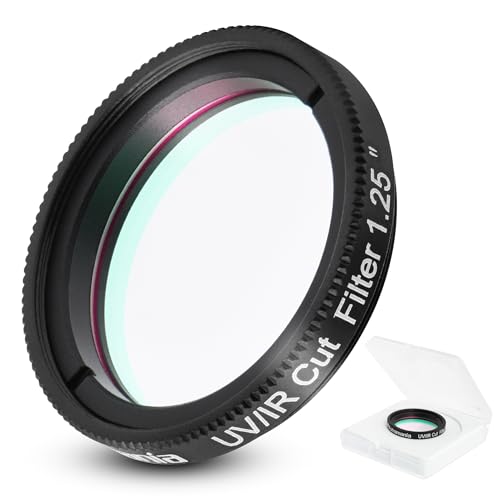
Astromania’s 1.25″ IR/UV Blocking Filter aims to sharpen planetary images by restricting UV and IR bands beyond the visible spectrum. It emphasizes a narrow transmission window around visible light to minimize blur from wavelengths that planets’ images can otherwise suffer from when using CCD cameras. This makes it a straightforward choice for planetary imaging routines where crispness is critical.
Best for: planetary enthusiasts seeking sharper, more defined disk details. Why selected: the filter specifically targets UV and IR extinction, which helps keep images crisp. Caution: the filter’s benefit is most noticeable when imaging planets; for deep-sky work, other filter types may be preferable depending on the target.
Desmond Ice UV IR Cut 49mm

Desmond’s Ice UV IR Cut 49mm filter is designed for CCD or CMOS sensors with a high-quality optical glass substrate and multi-coating to reduce reflections. It blocks UV rays below 390nm and IR rays above 750nm while delivering about 99.4% transmission within the 400-700nm range, supporting clear, color-accurate daytime to night-sky imaging.
Best for: mid-size sensor rigs needing a robust, compact 49mm option. Why selected: strong transmission in the core visible band combined with effective UV/IR blocking helps minimize color artifacts. Caution: 49mm size may require step-up/down adapters for some setups, so check barrel compatibility.
Desmond Ice UV IR Cut 82mm

The 82mm Desmond Ice UV IR Cut filter provides UV/IR blocking with high visible-band transmission for larger-aperture systems. This option suits owners with 82mm filter wheels or larger telescope accessories, aiming for consistent image quality across different targets and sessions.
Best for: imagers using bigger front-end optics that require a larger filter diameter. Why selected: similar coating quality and UV/IR blocking benefits as smaller variants, but scaled for higher optical throughput. Caution: larger filters may be heavier and require secure mounting to avoid tilt or misalignment woes.
Desmond Ice UV IR Cut 58mm

The 58mm Desmond Ice filter targets mid-sized imaging setups with reliable UV/IR blocking. Its high transmission in the visible spectrum and robust multi-coatings help deliver cleaner planetary and star-field images without introducing strong color shifts.
Best for: mid-sized telescope users who need a balanced filter for general-purpose imaging. Why selected: a versatile size that fits a broad range of systems. Caution: ensure your filter wheel or adapter supports 58mm to avoid vignetting or misalignment.
Buying Guide: Key Purchase Considerations
What to evaluate when selecting a UV/IR cut filter?
- Filter diameter and compatibility: Match the filter size to your optical train (1.25″, 2″, 49mm, 58mm, 58-82mm adapters, etc.).
- Transmission and wavelength blocking: Look for high visible-light transmission (roughly 400-700nm) with effective UV and IR blocking to reduce haloing and color artifacts.
- Coatings and reflections: Multi-coated, striation-free substrates minimize reflections and ghosting, improving contrast for both planets and nebulae.
- Durability and mounting: Permanent-lens-protector features add value; consider whether the filter needs to be easily removable for calibration or experiments.
- Target application: Planetary imaging benefits from strict UV/IR blocking; deep-sky work may require filters with specific transmission properties for certain emission lines.
- Ease of integration: Ensure your camera sensor type (DSLR, CCD, CMOS) is compatible with the filter’s transmission profile and physical size.
FAQ
- What does UV/IR cut filtration achieve for planetary images?
It reduces blur and chromatic aberration by removing wavelengths outside the visible band, helping planets appear crisper and with more natural color balance. - Is a larger filter always better?
Not necessarily. Larger diameters fit bigger setups but require compatible mounting and may add weight. Choose a size that matches your telescope and wheel or holder. - Can I use UV/IR cut filters for deep-sky imaging?
Yes, but some deep-sky targets may benefit from filters tuned to specific emission lines; in general, UV/IR blocking improves overall contrast. - Do all UV/IR cut filters block the same wavelengths?
No. Transmission profiles vary by brand and model, so verify the exact wavelength range blocked and the visible transmission percentage for your target. - Are these filters good for DSLR imaging?
Yes, the filters are designed to work with digital sensors, including DSLRs and dedicated astrophotography cameras, to improve image quality. - What maintenance is required for UV/IR cut filters?
Keep filters clean with a soft cloth and appropriate lens cleaning solution. Avoid touching the glass to prevent scratches that can degrade image quality.