Best Telescopes for Astrophotography Beginners and Easy Setup Guides
Introduction
For new stargazers, choosing a telescope that blends simple operation with solid imaging capabilities is essential. The following selections emphasize beginner-friendly design, automated or assisted tracking, and clear optics to help new photographers capture celestial detail without a steep learning curve. Each product is geared toward growing your skills from initial visual observing to captivating astroimages.
| Product | Brand | Key Benefit |
|---|---|---|
| ZWO Seestar S50 | ZWO | All-in-one smart telescope with autofocus and GoTo features |
| MEEZAA 90mm 800mm Refractor | MEEZAA | High-clarity optics with multi-coatings and easy setup |
| DWARFLAB Dwarf 3 Smart Telescope | DWARFLAB | Ultra-light, 4K auto-tracking for day and night imaging |
| Gskyer 70mm AZ Refractor | Gskyer | Portable travel scope with wireless remote and phone adapter |
| HEXEUM 80mm Portable Refractor | HEXEUM | Compact, multi-coated optics with flexible mounting |
ZWO Seestar S50 Smart Digital Telescope

The Seestar S50 integrates telescope hardware, autofocus, an astronomical camera, ASIAIR compatibility, and a dew heater in a compact form. Its lightweight construction supports straightforward setup, while built-in GoTo and a live star database streamline target acquisition. The optical system employs high-quality, low-noise imaging to deliver crisp celestial frames and reliable performance for beginners who want automated guidance without sacrificing image quality.
MEEZAA 90mm Refractor Telescope

This 90mm aperture refractor provides bright, high-contrast views with a fast 800mm focal length. It ships with two eyepieces, a 3x Barlow lens, and a sturdy equatorial mount that supports smooth tracking. The kit includes a phone adapter and carry bag, enabling quick capture sessions and easy transport for weekend observing sessions or light astrophotography practice.
DWARFLAB Dwarf 3 Smart Telescope

Designed for portability and versatility, Dwarf 3 weighs about 3 pounds and includes dual imaging modes with a cloud-processing capability. Its 4K auto-tracking system keeps celestial subjects in frame, while the dual-lens setup supports both wide celestial fields and closer targets. This model suits beginners seeking a compact, feature-rich device for both astronomy and nature photography.
Gskyer 70mm AZ Refracting Telescope

Gskyer offers a portable, beginner-friendly refractor with 70mm aperture and 400mm focal length. The kit includes multiple eyepieces, a 3x Barlow lens, a 5×24 finder, a smartphone adapter, and a wireless remote. The combination supports both scenic daytime photography and basic lunar or planetary imaging, making it a versatile travel-friendly option for learners on the go.
HEXEUM 80mm Portable Refractor
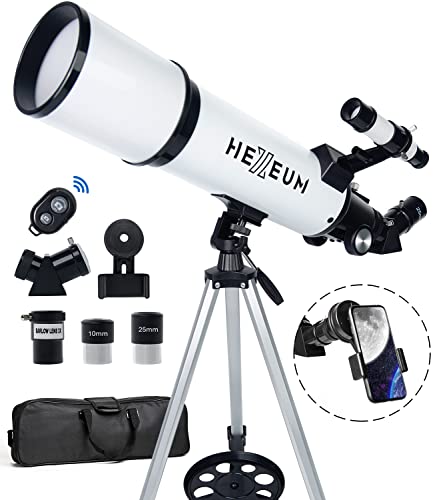
HEXEUM’s 80mm refractor emphasizes light-gathering and portability with a fully coated optical system. It supports two eyepieces and a 3x Barlow lens for flexible magnification, plus includes a carrying bag and a phone adapter for quick sharing of shots. The design prioritizes travel-ready usability for newcomers building confidence in both visual observing and basic imaging.
Buying Guide: Key Purchase Considerations
- Purpose and target use: Choose based on whether you primarily want automatic tracking, easy phone integration, or full manual control for learning optics fundamentals.
- Optical quality: Look for apochromatic optics or multi-coatings to minimize chromatic aberration and maximize light transmission for crisp star images.
- Mount and tracking: GoTo or dual-axis mounts simplify finding targets, while equatorial mounts offer smoother tracking for longer exposures.
- Portability and setup time: For beginners, a lightweight, quick-set telescope reduces friction to regular observing sessions.
- Expandability: Some models allow accessory upgrades (additional eyepieces, camera adapters, or software) as your skills grow.
- Compatibility with imaging devices: Ensure compatibility with your smartphone, camera, or dedicated astrophotography sensors for seamless capture experiences.
- Learning curve: Favor models with guided controls and clear manuals to accelerate getting started and maintaining motivation.
- Budget alignment: Beginners benefit from all-in-one kits that minimize the need to purchase separate components immediately.
- Durability and warranty: Consider build quality and manufacturer support, especially for travel-friendly or compact designs.
These considerations help balance optical performance, imaging capabilities, and practical usability as a beginner expands into astrophotography.