Best Surveillance Camera Test Monitors for on-Site Installations
Answering the needs of installers and security-system technicians, these surveillance camera test monitors are designed to test coaxial AHD/TVI/CVI/CVBS cameras and IP cameras alike. Each option below is chosen for reliability, practical features, and ease of use in field conditions. The best fit varies by project: some prioritize battery life and portability, others emphasize advanced IP testing and PoE power. The table below highlights the five selected devices and who they suit best.
| Product | Best For |
|---|---|
| Anpviz 5 Inch 4 in 1 CCTV Monitor Tester | Small jobs, on-the-go testing with long battery life |
| WANLUTECH 4K 12MP IP Camera Tester (E88) | IP-heavy setups, batch activation, SFP fiber testing |
| Triplett 8150 CamView IP Pro | Mixed camera types including 4K support |
| SGEF 4-in-1 Portable CCTV Tester | 4-in-1 analog testing with UTC/PTZ control |
| WANLUTECH Upgraded 8K IP Camera Tester (IPC-9800CADH Pro) | 8K/4K IP testing with advanced network tools |
Anpviz 5 Inch 4 in 1 CCTV Monitor Tester
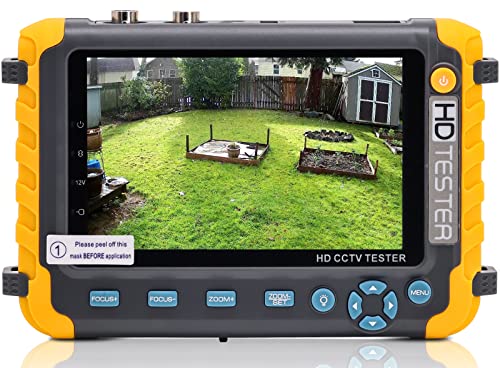
The Anpviz tester supports up to HD TVI testing for 2MP to 8MP cameras and displays the HD TVI image when connected. It operates as a portable 5-inch TFT-LCD device with a non-touch screen and 800×480 resolution. A built-in 18650 2600mAh battery provides up to 11 hours of use after a 3–4 hour charge, making it suitable for field technicians who need a compact, reliable tester for coaxial AHD/TVI/CVI/CVBS cameras.
Best for: On-site technicians who need a compact, all-in-one tester for coaxial analog systems and light IP work. The long battery life and handheld form factor support quick verification in the field.
Limitation: Non-touch screen may slow navigation for some users; primarily focused on analog testing with TVI emphasis.
WANLUTECH 4K 12MP IP Camera Tester (E88)

This tester supports up to 8K/4K IP cameras and provides PoE output up to 90W, enabling temporary power for PTZ cameras and other PoE devices. It features an 8-inch touchscreen, IP discovery, rapid video testing, and a SFP port for fiber testing. It also supports batch activation of cameras, IP address changes, and password management, plus analog camera testing, HDMI/VGA input, and a suite of network tools.
Best for: IP-centric projects with high-power PoE requirements and fiber networking needs. It helps speed up bulk camera deployment and network verification.
Caution: The device is feature-rich, which may require a learning curve for users new to advanced IP testing and SFP configurations.
Triplett 8150 CamView IP Pro

The Triplett CamView IP Pro is a compact tester with an 8MP capability, offering HDMI, BNC, and RJ45 ports, PoE support, and a 12V DC output. It supports IP cameras, analog cameras, TVI, CVI, and AHD cameras, including 4K H.264/H.265 testing, and can connect to WiFi for hotspot creation. It also provides basic Ookla speed testing.
Best for: Mixed camera environments requiring versatile support across IP and analog formats, with a focus on straightforward operation and portable use.
Limitation: The emphasis on broad compatibility may mean some advanced IP features require extra steps to access.
WANLUTECH Upgraded 8K IP Camera Tester (IPC-9800CADH Pro)

This 7-inch touchscreen tester supports up to 8K IP cameras and 8MP AHD/TVI/CVI cameras, plus CVBS analog. It includes a 90W PoE power output, a 1-channel BNC input, and a BNC looped output. The device also supports OSD, UTC control, and a suite of network tools, including IP discovery and VF testing. It is designed to handle both advanced IP testing and traditional coaxial testing in one unit.
Best for: Installations needing high-resolution IP testing, Power over Ethernet capability, and robust network-tool access in one portable device.
Limitation: Larger screen size and breadth of features may require more screen time to master for simple tasks.
Buying Guide
What camera types do you test?
Consider whether you need to test coaxial AHD/TVI/CVI/CVBS cameras, IP cameras, or both. If your work is mainly analog, a tester with strong AHD/TVI/CVI/CVBS support and UTC/OSD control is ideal. For IP-heavy installations, prioritize PoE output, IP discovery, VLAN handling, and robust network tools.
How important is PoE power output?
PoE power is crucial when testing and powering cameras on-site. Devices offering high-wattage PoE (e.g., 90W) can power PTZ cameras temporarily, reducing the need for extra supply adapters. If you frequently field-test PoE cameras, choose a tester with reliable PoE support and multiple power options.
What screen size and interface matter?
Smaller screens are highly portable for quick checks; larger screens simplify detailed analysis. Touchscreen interfaces speed navigation, but some testers rely on physical buttons for reliability in dusty environments. Evaluate whether you prefer a touchscreen, non-touch, or hybrid interface.
How about network tools and testing capabilities?
Advanced testers offer IP discovery, DHCP, PING, traceroute, speed tests, and SFP fiber support. If your work involves complex networks, prioritize devices with these tools and clear reporting features to document field tests.
Portability vs. capability
Trade-offs exist between portability and breadth of capability. Smaller units excel in field work and quick checks, while larger devices pack more features for comprehensive lab-like testing. Align the choice with your typical job scope and site conditions.
Compatibility and future-proofing
Look for devices that support current standards (4K/8K IP, H.265/H.264, ONVIF PTZ) and easy firmware updates. A tester that covers both current and near-future camera formats reduces the need for frequent tool changes.
FAQ
- What is the main difference between analog and IP testers? Analog testers focus on coaxial AHD/TVI/CVI/CVBS cameras, while IP testers handle IP cameras and PoE-powered devices, plus network testing tools.
- Do these testers require external power? Most include a built-in battery or DC power output options; some designs rely on external power for large IP cameras. Check the power specs of your chosen model.
- Can I test PTZ control with these devices? Yes, most listed testers support RS485 or coaxial PTZ control through UTC/OSD interfaces or dedicated PTZ protocols.
- Is 4K or 8K support common in testers? Higher-end models support 4K and even 8K IP cameras, but ensure your device matches the camera resolution you deploy.
- Do testers include fiber testing capabilities? Some models feature SFP ports for fiber testing, useful in fiber-backed networks; others focus on coaxial and IP networks.
- Should I buy a tester with a large screen? A larger screen improves visibility for complex feeds and detailed comparisons, but reduces portability. Choose based on your typical work environment.