Best Photo and Negative Scanners for Quick Digitizing of Memories
If you’re archiving old photos, negatives, and slides, you want a scanner that’s simple to use, quick, and reliable. This guide highlights five top all-in-one photo scanners with built-in LCD screens that don’t require a computer. They’re ideal for retirees, busy families, hobbyists, and small offices looking to convert 35mm, 126, 110, and 135 film, slides, photos, and even business cards into high-quality digital files. Read on to compare features, who each model suits best, and practical buying tips.
Quick product snapshot
- DigitPro Photo Scanner and Film Digitizer — best for all-in-one convenience and standalone operation
- KODAK Slide N SCAN Film & Slide Scanner — best for large, gallery-style viewing on 5” LCD
- DigitPro Film and Slide Scanner — best for versatile formats in a single device
- Kedok Photo, NameCard, Slide & Negative Scanner — best gift-ready option with all-in-one support
- ClearClick QuickConvert 2.0 — best for quick, on-the-go scanning with built-in battery
Summary of chosen products:
| Product | Best For | Key Advantage | Included Memory |
|---|---|---|---|
| DigitPro Photo Scanner and Film Digitizer | Older photos, slides, negatives | Large 5” screen; simple one-touch | 8GB SD Card |
| KODAK Slide N SCAN | Wide film collection; gallery-style review | 5” LCD with gallery mode | Not included |
| DigitPro Film and Slide Scanner | Multi-format archiving | All-in-one with easy load | Internal 128MB + SD card |
| KEDOK Photo, NameCard, Slide & Negative Scanner | Great gift; family memories | 4-in-1 support | 8GB SD Card |
| ClearClick QuickConvert 2.0 | Fast, on-the-go digitizing | Rechargeable; no computer | Internal battery |
DigitPro Photo Scanner and Film Digitizer
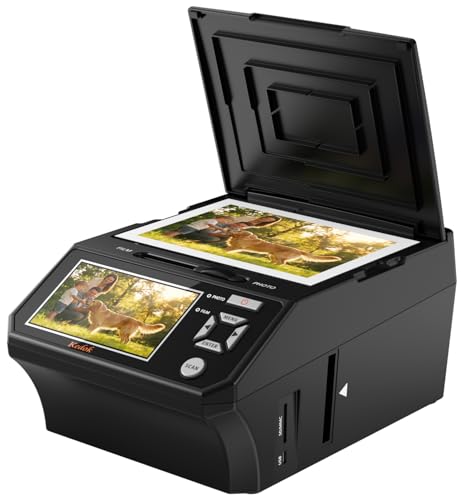
This all-in-one scanner supports 35mm slides, 135 and 110 negatives, printed photos, and business cards, turning old memories into 22MP digital images without a computer. It features a 5-inch LCD for immediate viewing and simple one-touch operation. Best for users who want a standalone device that handles multiple formats in one go, with a focus on ease of use for seniors or busy households. A potential limitation is the built-in memory size, which may require the included SD card for larger batches.
KODAK Slide N SCAN Film & Slide Scanner
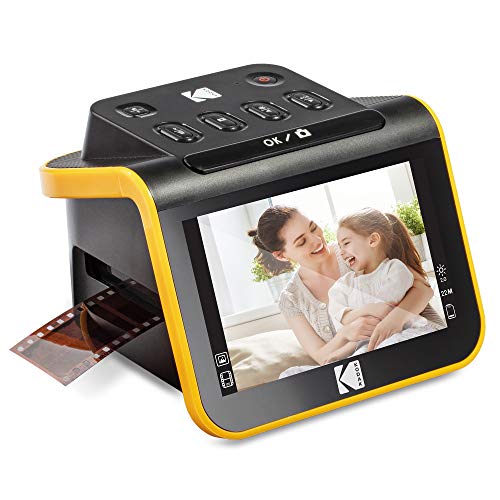
This model emphasizes convenience with a 5” LCD and gallery mode for previewing, editing, and sharing before saving to SD cards (not included). It’s ideal for users who want to quickly convert 135, 110, and 126 film and slides and enjoy reviewing the results on a larger screen. The device includes adapters and a slide holder for smooth operation, though SD card storage must be managed separately.
DigitPro Film And Slide Scanner

This all-in-one scanner preserves photos, slides, and negatives (including 35mm, 135, 110, 126, and even Super 8) to 22MP digital images. It has a 5” LCD for instant viewing and supports saving to internal memory or an SD card. The one-touch scanning makes it approachable for beginners. A caution: external memory up to 64GB is recommended if digitizing large libraries in one session.
KEDOK Photo, NameCard, Slide & Negative Scanner

This 5” LCD-based unit handles 135 and 110 negatives, 135 films, slides, name cards, and prints (3R–5R), with an 8GB SD Card included. It’s a solid gift option due to its varied format support and built-in memory. It’s best for families with mixed media and who want a single device to cover most scanning needs. A limitation to note: SD card capacity may limit batch conversion without swapping cards.
ClearClick QuickConvert 2.0
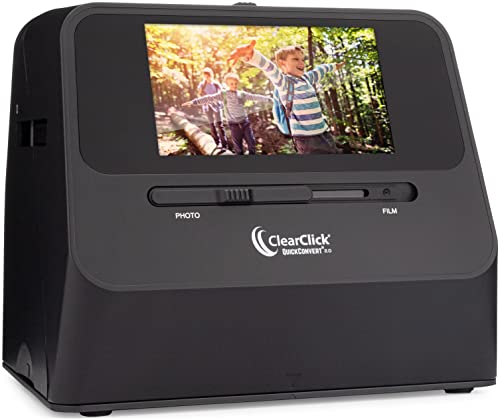
Designed for speed and portability, this scanner handles 4×6 photos and 35mm, 110, and 126 films with no computer required. It uses a built-in 22MP interpolation for image output and a 5” LCD screen for immediate viewing. It’s best for users who value quick, one-row scanning without software, though the absence of an automatic feeder means small batches are easier to manage with manual feeding.
Plustek Photo Scanner ePhoto Z300

Though not among the initial five, Plustek ePhoto Z300 is referenced for comparison due to its fast 4×6 scanning and auto-crop/deskew features. This model is best for users who frequently batch-scan standard photo sizes and want optimized crop results. It’s a useful benchmark for understanding how dedicated photo scanners compare against all-in-one film-and-photo devices.
Buying Guide: How To Pick The Right Scanner
What to consider when choosing a photo and negative scanner:
- Format support: Do you need to digitize 35mm, 110, 126, slides, photos, or business cards? Pick a model that covers your primary media.
- One-touch vs. adjustable settings: If you want simplicity, prioritize devices with one-touch scanning and built-in software. If you prefer color, brightness, or date/time adjustments, choose a model with adjustable options.
- Display and workflow: A large LCD screen helps preview scans without a computer. A stand-alone device saves space and reduces setup time.
- Memory and storage: Internal memory plus external SD cards are essential for large libraries. Ensure compatibility with sizes up to 32–64GB depending on the model.
- Portability and power: Battery-powered options are ideal for on-the-go archiving, while plug-in models suit desk-bound use.
- Quality vs. speed: Interpolated 22MP output offers crisp results, but consider true optical resolution when comparing models.
Common buyer questions
- Do I need a computer to use these scanners? Most listed models operate standalone, saving to internal memory or an SD card, though some can export via USB or HDMI if connected to a computer.
- What media sizes are supported? Look for models supporting 35mm negatives, 110/126 negatives, slides, 3R–5R photos, and business cards for complete archiving.
- What about color accuracy? Large LCD previews help, but check for built-in color adjustment features to improve brightness and contrast before saving.
- Is there a best option for seniors? Yes—models with large 5” LCDs, simple one-touch scanning, and no software installation are ideal for users who prefer straightforward operation.
- Can these scanners handle Super 8 film? Some models advertise Super 8 compatibility; verify exact film compatibility in the product specs before purchasing.
- What about file formats? Most outputs are JPEG; some may offer TIFF or RAW through optional connections. Ensure it matches your storage and editing workflow.
Quick comparison by scenario
- Best for all-in-one convenience: DigitPro Photo Scanner and Film Digitizer
- Best for gallery-style viewing: KODAK Slide N SCAN
- Best multi-format value: DigitPro Film and Slide Scanner
- Best gifting option: KEDOK Photo, NameCard, Slide & Negative Scanner
- Best for quick, on-the-go scanning: ClearClick QuickConvert 2.0
FAQ
- What resolution do these devices capture at? Most scanners provide high-quality 22MP outputs or similar, with some offering interpolated enhancements. Check the product spec for exact numbers.
- Do these scanners require software installation? The intended design is standalone operation, minimizing or eliminating software setup.
- Can I scan business cards? Some models include support for business cards and name cards, expanding archival options.
- Is an SD card included? Several models include an SD card (commonly 8GB or 4GB); others require you to purchase one separately.
- Which model is best for large photo collections? Models with rapid one-touch scanning and ample or expandable memory are preferable for bulk projects.
- Are these suitable for beginners? Yes, especially units with intuitive controls and large LCD previews designed for easy use.