Best Overhead Tripod for DSLR: Stable, Flexible Stills and Panoramas
When shooting overhead, you need a tripod that combines height, stability, and smooth pan/tilt action. This guide reviews five top overhead tripods designed for DSLR use, focusing on load capacity, center-column versatility, and ease of setup. Each option helps you capture macro, tilt, panorama, and overhead shots with confidence, whether you are in a studio or on location.
| Product | Height Range | Load Capacity | Key Feature |
|---|---|---|---|
| NEEWER 72″ Camera Tripod Monopod | 0.9 ft – 6 ft | 33 lb / 15 kg | Horizontal/360° panning center column |
| K&F CONCEPT 90”/230cm Overhead Tripod (T254A7+FH-03) | 0.9 ft – 7.5 ft | 10 kg / 22 lb | Universal center axis with 0–120° tilt |
| K&F Concept 90”/230cm Ultra High Tripod (T254A7+BH-28L) | 0.9 ft – 7.5 ft | 10 kg / 22 lb | Patent gimbal for 0–120° tilt, 360° rotation |
| Fotopro 68″ Camera 360 Horizontal Tripod | ~1.5 ft – ~5.25 ft | 8 kg / 17.6 lb | 360° horizontal rotation with 200° vertical range |
| NEEWER 79″ Camera Tripod Monopod | 1.9 ft – 6.5 ft | 33 lb / 15 kg | Vertical or horizontal column, quick height adjustment |
Below are five overhead tripods that balance reach, stability, and adaptability for DSLR work. Each entry includes a direct, clickable Amazon link for quick access and a visual reference to help you compare at a glance.
NEEWER 72 Inch Tripod With Center Column
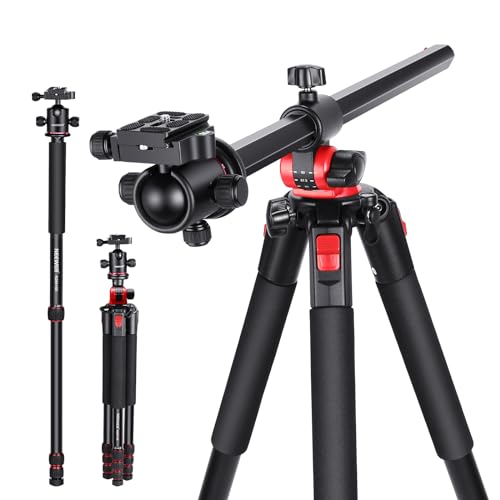
This aluminum tripod offers a sturdy 1.1” (28 mm) tube diameter and a maximum load of 33 lb (15 kg), making it suitable for DSLR rigs and video cameras. A center-column that can rotate 0°, 22.5°, 45°, 67.5°, or 90° enables vertical and horizontal shooting, including macro and panoramic work. The Arca-type quick-release plate and dual bubble levels help maintain precise alignment. A carabiner allows extra stabilization with a sandbag if needed, and a pan-tilt head with three adjustment knobs supports quick composition changes.
Pros: High load capacity, flexible center-column angles, Arca compatibility, added stabilization options. Considerations: Heavier setup; transport may require a sturdy bag.
K&F CONCEPT 90”/230cm Overhead Tripod (T254A7+FH-03)

This model emphasizes extended reach with a maximum height of 2.3 m (90 inches) and a 28 mm tube diameter for stability. It features a detachable monopod option and a 4-section leg design that collapses to compact 54 cm. The universal center axis supports 0–120° pitch and full 360° panorama, ideal for overhead landscapes, product shots, and macro work. Its lightweight construction aids portability for outdoor shoots.
Pros: Deep height, versatile center axis, portable and stable. Considerations: May require careful setup to maximize stability in windy outdoor settings.
K&F CONCEPT 90” Ultra High Tripod (T254A7+BH-28L)

This variant highlights a patent gimbal with a 0–120° tilt and a full 360° rotation, allowing expansive overhead panoramas and flexible overhead angles. The 28 mm center column enhances stability in horizontal positioning, while the four-section legs provide a collapsed height suited for travel. It remains compatible with DSLR bodies and camcorders, and a detachable monopod option extends shooting versatility.
Pros: Superior tilt/rotation range, robust stability, travel-friendly. Considerations: Higher price point relative to basic models.
K&F Concept 76 Inch Tripod With Rotatable Center Column

This compact option features a rotatable center column capable of 0–180 degrees and 360-degree horizontal rotation, delivering versatile overhead, panorama, and macro shots. The 28 mm diameter tubes and 4-section legs balance altitude and stability while remaining travel-friendly. A lightweight design supports easy transport to varied locations.
Pros: Flexible center column, solid stability, portable. Considerations: Lower maximum height compared to taller models.
Fotopro 68 Inch 360 Horizontal Tripod

The Fotopro model offers a 360° horizontal rotation with a vertical tilt range of up to 200°, supporting diverse overhead, product, and macro shots. The four-section legs extend from a compact 22.5 cm to 159 cm, with a recommended load of 8 kg and a maximum of 10 kg. Its CNC-machined metal components contribute to durability and longevity for frequent use.
Pros: Excellent horizontal rotation, strong build quality, travel-friendly. Considerations: Slightly heavier than some ultra-lightweights; ensure compatibility with your camera rig.
Buying Guide: Key Considerations For Overhead DSLR Tripods
- Height and reach: If you shoot macro or overhead product shots, a higher maximum height helps you clear the subject while keeping the camera above the workspace. Consider models offering 2.3 m (90″) or more.
- Center-column versatility: Look for center columns that can shoot vertically and horizontally, with 0–120° tilting and 360° rotation for panoramic or macro flexibility.
- Load capacity: Choose a tripod that comfortably supports your DSLR plus lenses and any accessories. A 15–22 kg (33–48 lb) range is ample for most professional DSLRs with common lenses.
- Stability features: Aluminum or magnesium alloys with large-diameter tubes improve rigidity. Some models include dual bubble levels and anti-slip feet for uneven surfaces.
- Portability and setup time: If you travel often, prefer four-section legs with a manageable collapsed height and included carrying bag. Quick-release plates (preferably Arca-type) speed up changes between shots.
- Monopod conversion: Some setups convert into a monopod for handheld use with minimal equipment changes, increasing shooting versatility in tight spaces.
- Compatibility: Ensure the tripod’s mounting plate and screw standards align with your camera (3/8″ and 1/4″ interfaces are common). An included phone holder or accessory kit can be helpful for streaming or vlogging.
- Price vs. value: While higher-end models provide smoother panning and stability, mid-range options still deliver reliable overhead performance for most DSLR workflows.