Best on-Camera Field Monitors for Clear, Pro-Grade Video Monitoring
Answering the demand for reliable external displays, these on-camera field monitors help you frame, expose, and focus with confidence. They’re ideal for independent creators, documentary shooters, event videographers, and vloggers who need a brighter, more accurate view than a camera’s built-in screen.
Below is a concise, buyer-friendly guide highlighting five strong options. A quick summary table follows for fast comparison of core specs and use cases.
Product Comparison Quick Reference
| Product | Best For | Key Benefit | Compact/Portable |
|---|---|---|---|
| NEEWER F700 7″ Monitor | Indie filmmakers, run-and-gun crews | High brightness, 3D LUTs, 4K HDMI loop | Yes |
| FEELWORLD FW759 | Indoor/outdoors with lightweight rig | 4K HDMI input, accurate focus tools | Yes |
| FEELWORLD S55 V3 | Budget-conscious creators | 6″ IPS, robust focus tools, LUT support | Yes |
| FEELWORLD F5 Prox | Outdoor shoots, quick setup | 1600 nit brightness, 3D LUT, portable | Yes |
| FEELWORLD SC6 | Multi-camera and field rigs | 3G-SDI + 4K HDMI, rugged aluminum | Yes |
NEEWER F700 7″ Camera Field Monitor

The NEEWER F700 is a 7-inch, 2000-nit touchscreen IPS monitor with 1920×1080 resolution and a 180-degree adjustable bracket. It supports 4K HDMI loop in/out and a 3.5mm headphone jack for audio monitoring. It ships with two NP-F750 batteries, which makes it better for longer shoots without frequent power swaps. This monitor offers built-in professional tools, including False Color, Zebras, Histogram, Full Waveform, and Vectorscope, plus 3D LUTs that can be uploaded for custom looks.
Best for: Video teams and solo operators who need bright outdoor visibility, flexible power, and a wide array of professional tools in a single compact unit. It’s a solid all-around choice for documentary work and field shoots where reliability matters.
Caution: The 2000-nit brightness model can be power-hungry; plan for battery life and consider outdoor shade when shooting in direct sun.
FEELWORLD FW759 7″ On-Camera Monitor

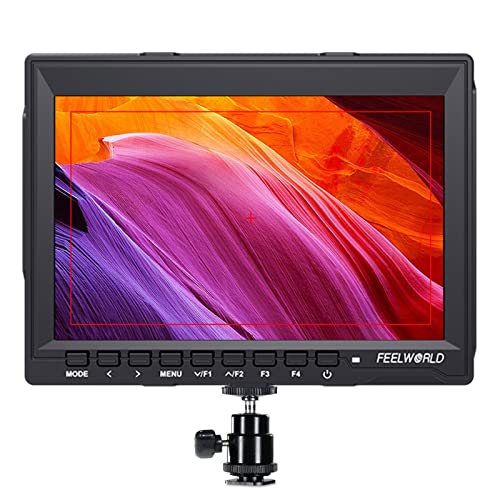
FEELWORLD FW759 delivers a larger viewing experience with a 7-inch, 1280×800 IPS panel and a 4K HDMI input. It emphasizes accurate focus and exposure with Focus Peaking, Histogram, False Color, Over Exposure Warning, and Zoom. The monitor is designed for indoor use and travel shoots, featuring a slim profile (about 17 mm) and a light build (~300 g), with a sunshade included for outdoor visibility.
Best for: Creators prioritizing a balance of screen real estate and portability, especially when shooting in controlled indoor spaces or on the move where weight matters. It’s a practical pick if you want reliable tools without extra bulk.
Caution: Bright outdoor sun may still wash out the screen without the sunshade, and brightness is more modest than higher-nit displays.
FEELWORLD S55 V3 6″ Monitor

The FEELWORLD S55 V3 is a compact 6-inch monitor with a Full HD 1920×1080 IPS screen and a 450-nit brightness rating. It includes essential professional tools such as Waveform, Vectorscope, RGB Histogram, Focus Assist, False Color, and LUT support. A sun hood improves outdoor visibility for brighter environments. The unit is designed for indoor and controlled outdoor settings, offering reliable monitoring without heavy gear.
Best for: Quick-focus and exposure checks in small rigs, handheld setups, or on gimbals where a compact, feature-rich monitor is needed without adding bulk.
Caution: The 450-nit brightness may be challenging in direct, bright sunlight compared to higher-nit options.
FEELWORLD F5 Prox 5.5″ Monitor

The FEELWORLD F5 Prox is a compact 5.5-inch monitor with 1600 nit brightness. It provides professional monitoring tools like focus peaking, waveform, histogram, and HDR with 3D LUT support for real-time log previews. It’s designed for outdoor shoots and features a lightweight form factor that’s easy to mount on smaller rigs, with battery compatibility (F750) and a carrying bag for portability.
Best for: Filmmakers and vloggers who need a bright, pocket-sized monitor for outdoor or fast-paced setups, where a larger screen isn’t feasible. Choose this if you want strong visibility in daylight with professional LUT preview.
Caution: The 5.5-inch size limits the amount of on-screen information you can display at once; you may trade off some data density for portability.
FEELWORLD SC6 6″ Studio-Grade Monitor
The FEELWORLD SC6 combines a bright 1500-nit display with rugged aluminum housing, making it well-suited for outdoor production and demanding environments. It offers 3G-SDI and 4K HDMI inputs/outputs, helping streamline multi-camera setups and signal routing on location. Pro-level tools include Waveform, Vectorscope, Histogram, Zebra, False Color, Focus Peaking, and HDR monitoring. It supports 3D LUTs for real-time log previews and robust external monitoring workflows.
Best for: Field productions and multi-camera shoots where signal flexibility, durability, and high brightness are priorities. It’s a strong choice for documentary teams or location shoots with varied lighting and rig configurations.
Caution: The combination of SDI and HDMI makes this unit heavier than pocket monitors; ensure your rig can support the extra weight on small rigs.
Buying Guide: Key Considerations For Selecting an On-Camera Field Monitor
- Brightness and readability: Outdoor shoots benefit from higher nit ratings (1000+ nits). For bright sunlight, look for 1500–2000 nits, or use a sun hood and shade on smaller displays.
- Resolution and panel type: A higher resolution (Full HD or 4K input support) with an IPS panel improves color accuracy and viewing angles, aiding critical focus and exposure checks.
- Monitoring tools: Essential tools include waveform, vectorscope, histogram, focus peaking, zebra, and false color. LUT support enables real-time preview of color grades or log footage.
- Inputs/outputs: Consider 4K HDMI input/output for future-proofing. If multi-camera work is common, SDI availability can be decisive.
- Power options: Battery compatibility (NP-F, LP-E6) and life. Some monitors include bundled batteries; others rely on common external power options.
- Size and weight: Balance screen size with rig ergonomics. Larger screens help in bright environments but add heft; smaller monitors are easier for handheld or gimbal work.
- Build and durability: Aluminum housings and rugged construction benefit outdoor and field use. Weather resistance and heat management are practical considerations.
Frequently Asked Questions
- What is the advantage of an on-camera field monitor?
- How bright should a field monitor be for daylight shooting?
- Is 4K support necessary on a field monitor?
- What troubleshooting tips help when a monitor won’t display HDMI input?
- Are LUTs important for real-time monitoring?
- How do I choose between HDMI and SDI on-field monitors?
Answers
- External monitors provide larger, brighter screens with professional tools for better focus, exposure, and framing than most built-in cameras.
- For daylight shoots, aim for monitors offering 1000–2000 nit brightness or use sun hoods and shade to improve visibility.
- 4K support helps future-proof your setup and allows higher-fidelity previews when paired with compatible cameras and recorders.
- Check cable connections, ensure correct input/output settings, and verify firmware compatibility if no signal is detected.
- LUTs enable quick preview of the final color grade, reducing guesswork during logging and shooting.
- HDMI is common and versatile; SDI offers longer cable runs and robust reliability for multi-camera rigs.