Best Negative Scanner to Digital: Turn Your Old Negatives and Slides Into Modern Photos
Seeking a reliable way to convert film negatives and slides into high-quality digital files? This guide highlights five top options that balance image quality, display size, and ease of use. Each pick is suited to different buyers—from casual family historians to serious archivists. Read on to see who each scanner is best for and why they were chosen, plus practical buying tips and answers to common questions.
| Product | Best For |
|---|---|
| KODAK Slide N SCAN | All-around versatile with a built-in LCD and quick-feed tray for continuous loading |
| Magnasonic All-in-One 24MP | High resolution, built-in memory, and HDMI viewing for enthusiasts |
| DigitPro Film and Slide Scanner | Budget-friendly, straightforward one-touch scanning |
| PORTTA Film Scanner | No-computer scanning with optional HDMI output |
| KODAK Slide N Scan Max | Quality tilting LCD and gallery-style preview for easy editing |
KODAK Slide N SCAN Film & Slide Scanner

Best for: collectors and casual users who want a comprehensive all-in-one solution with a 5” LCD gallery view. This 22MP scanner handles 135, 110, 126 film and slides, saving to SD (card not included). It includes a 50mm slide holder and adapters, enabling quick, continuous loading. The large display makes it easy to preview, edit, and share photos without a computer. Caution: SD card not included, so you’ll need a compatible card to store scans.
Magnasonic All-in-One 24MP Film Scanner

Best for: imaging enthusiasts who value high resolution, built-in memory, and the option to view on a TV or monitor via HDMI. It scans 35mm/110/126/Super 8 film and slides to 24MP JPEGs, with 128MB internal memory and a card slot for up to 128GB. Caution: HDMI cable is not included, so you’ll need to supply one if you want to view on a TV or monitor.
DigitPro Film And Slide Scanner

Best for: users who want a simple, all-in-one device for 35mm, 126, 110 negatives, and slides with a 5” LCD. It supports 22MP and 128MB internal memory with SD card expansion up to 64GB. Caution: external SD card not included, so storage requires a card purchase. The one-touch scanning makes digitizing large collections straightforward.
PORTTA Film Scanner with 5″ LCD

Best for: shoppers who want a no-computer workflow with flexible output. It offers 16MP or 22MP scans, a 5″ LCD for direct preview, and an HDMI option. It supports 135, 126, 110 film and slides, and can store images on an SD card (not included). Caution: 22MP mode may take slightly longer to scan than lower resolutions.
KODAK Slide N Scan Max Digital Film Scanner

Best for: users who want a tiltable 7” LCD and a gallery-style preview to ease editing. The 13MP sensor supports color and B&W negatives, with a continuous loading slide feeder for faster digitization. Caution: tiltable screen adds cost; consider whether you need the larger display versus a simpler model.
35mm Film & Slide Scanner with 2.4″ LCD

Best for: those who want a compact, standalone device with a small LCD and TV-out sharing. It supports 135 negatives and slides and includes a fast slide feeder for quick processing. Caution: smaller 2.4″ screen may be less comfortable for detailed editing; might require external viewing to verify edits.
DigitPro Photo Scanner And Film Digitizer
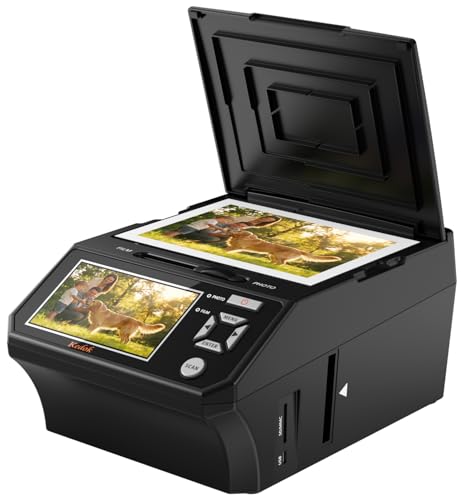
Best for: households digitizing a broad mix of 35mm slides, 135 and 110 negatives, plus printed photos and business cards. It features a 5” LCD, 22MP digital output, and includes an 8GB SD card. Caution: 8GB card included; larger collections will benefit from a larger card for expanded storage.
Buying Guide
- What resolution do you need? If you want sharp archival copies, aim for 22–24MP output. Higher resolution captures more detail but larger file sizes.
- Display size matters. Larger LCDs simplify framing and editing; smaller displays speed up compact setups but may require external viewing.
- Storage options. Look for built-in memory when you want stand-alone use, and SD card support for easy expansion.
- Input formats. Ensure the scanner supports your film types (35mm, 110, 126, Super 8) and slides to avoid extra adapters.
- One-touch simplicity vs. advanced controls. If you prefer quick results, choose scanners with one-touch scanning; for precise edits, seek devices with software features.
- Connectivity. If you plan to view on a TV or monitor, HDMI output can be valuable; ensure cables are included or available.
FAQ
- Do these scanners require a computer? Some models work standalone with built-in memory and LCD; others need a computer or SD card for saving files.
- What film types are supported? Most scanners in this list support 35mm, 110, 126, and some support Super 8; verify each model before buying.
- Can I edit scans on the device? Many offer basic on-device adjustments; for advanced editing, you’ll want to transfer files to a computer.
- Is HDMI output essential? If you want to view scans on a TV or monitor, HDMI output is helpful, though not always included with cables.
- Which is best for beginners? Look for one-touch scanning and a large LCD for easy preview and operation.
- Do these devices require software? Most models include simple built-in software; some may rely on external software for advanced features.