Best Macro Full Frame Lenses for Ultra-Censitive Close-Ups in 2026
If you need true 2x or higher macro capability on a full-frame sensor, these lenses are built to deliver ultra-detailed close-ups. Best for product photography, nature close-ups, and jewelry shots, each option targets a different shooting style and camera system. The table below highlights five strong choices and who they’re best for.
| Product | Best For | Magnification | Mount Type |
|---|---|---|---|
| TTArtisan 100mm F2.8 2X Macro | Stills photographers needing superb subject isolation | 2x | Canon/Nikon/Sony mirrorless variants |
| Tamron 90mm F/2.8 Di III VXD | Sony E-mount macro with strong optics | 1:1 | Sony E |
| 7artisans 60mm F2.8 Macro 2X | Budget-friendly 2x macro for Sony E and similar | 2x | Multiple mirrorless mounts |
| AstrHori 120mm F2.8 Macro | Longer working distance macro for landscapes and nature | 2x | Nikon Z / broader full-frame adapters |
| AstrHori 25mm F2.8 Macro 2-5X Ultra | Ultra-close macro with wide-angle approach | 2x–5x | Full-frame mirrorless |
TTArtisan 100mm F2.8 2X Macro Full-Frame Lens

2x magnification lets you reproduce life-size details on subjects such as insect textures or pollen structures at a short 9.8″ focusing distance. This lens is aimed at macro enthusiasts who want true macro reproduction with edge-to-edge sharpness and smooth background blur.
Best for: Still-life and nature photographers who want high-detail macro with minimal distortion and strong subject separation at a relatively forgiving working distance.
Why chosen: It offers true 2x magnification and a pro-grade bokeh system with a 12-blade aperture, ideal for clean portraits of small subjects and jewelry blogs. The cold shoe expansion hub adds creative versatility for lighting or audio accessories.
Caution: The macro-focused design can be limited in standard distance, so plan your shots around close-focusing use rather than general photography.
Tamron 90mm F/2.8 Di III VXD Macro (Sony E)

This lens emphasizes high optical performance with excellent flat-field reproduction. It delivers strong image fidelity for macro work and is especially suitable when you want precise color and contrast across the frame.
Best for: Sony full-frame users seeking sharp macro results with minimal edge softness and reliable performance in a compact package.
Why chosen: It offers very solid macro performance with a practical working distance and reliable image quality across the frame, making it a strong all-around macro option.
Caution: Use a stable tripod and fast shutter speeds to manage motion at higher magnifications and avoid blur in handheld shots.
7artisans 60mm F2.8 Macro 2X for Sony E
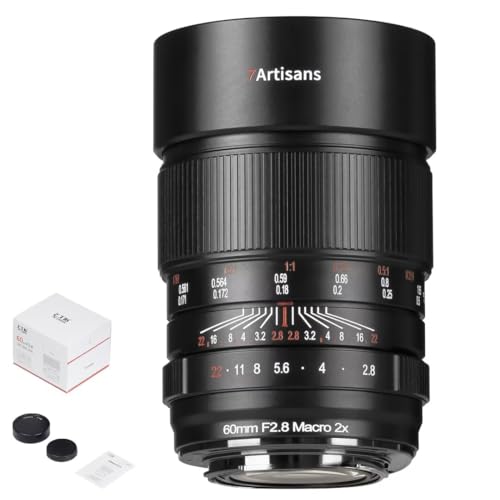
The 60mm 2x macro lens provides a bright F2.8 aperture with a 12-group, 14-element design, including ED and high-refractive-index elements for clear, high-contrast images. The lens focuses specifically for macro work with strong subject separation.
Best for: Budget-conscious macro shooters who want a dedicated 2x magnification with good edge-to-edge detail on Sony E-mount cameras.
Why chosen: Its robust optical design reduces ghosts and glare while delivering strong close-up images at a reasonable price point.
Caution: It is tailored for macro use; infinite focus is not applicable, so plan around macro work only.
AstrHori 120mm F2.8 Macro (Nikon Z / Full-Frame)

With 2x magnification and a longer working distance, this macro lens is well-suited for subjects where you want more space between camera and subject, like insects or small flora in a natural setting.
Best for: Nature and macro shooters who need extra working distance and a balanced bokeh for full-frame captures.
Why chosen: It doubles as a capable portrait lens at longer distances, offering versatility beyond macro use.
Caution: May require a careful setup to manage depth of field at higher magnifications.
AstrHori 25mm F2.8 Macro 2-5X Ultra Macro

This ultra macro lens covers a wide magnification range from 2x to 5x, with a short working distance and a 37.5–45mm working distance. It is designed specifically for macro work on full-frame mirrorless cameras.
Best for: Close-up enthusiasts who need flexible magnification options for insects, pollen, or plant textures in tight spaces.
Why chosen: The 2x–5x range accommodates a variety of macro scenarios, from moderate to extreme macro shots, with a relatively wider depth of field for its magnification.
Caution: Not designed for infinity focus; plan shoots around macro work.]
Buying Guide: Key Considerations For Macro Full-Frame Lenses
- Magnification and working distance: Decide between 1:1, 2x, or 2x–5x depending on subject size and space. A longer working distance helps with lighting and subject handling.
- Mount compatibility: Ensure the lens matches your camera system (Sony E, Nikon Z, etc.).
- Aperture and bokeh: A wider aperture (like f/2.8) provides pleasing background blur but may reduce depth of field at high magnification. Consider stopping down for sharpness while maintaining subject separation.
- Optical design and coatings: Look for elements that suppress ghosts and glare, especially in bright macro setups with reflected light.
- Tripod and stabilization: Macro work benefits from stable setups and, where possible, macro rails or focus stacking workflows to increase depth of field.
Frequently Asked Questions
- What is the difference between 1:1 and 2x macro magnification?
1:1 reproduces life-size on the sensor; 2x magnification offers larger close-ups with increased working distance in some lenses. - Do macro lenses work on full-frame cameras with adapters?
Some macro lenses can be adapted to different mounts, but performance varies. Check native vs. adapter-supported compatibility for your body. - Is a longer focal length better for macro?
A longer focal length provides more working distance and can reduce subject shadow, but it may introduce more pronounced vignetting in some designs. - Should I use a tripod with macro lenses?
Yes. A tripod or stable support helps minimize camera shake at high magnifications and enables consistent framing for focus stacking. - Are macro lenses suitable for portraits?
Some macro lenses double as portrait lenses at broader compositions, but they are optimized for close-up work; expect different perspective effects at longer distances.