Best Lightweight Travel Camera Tripods for Easy on-the-Go Photography
For travelers and outdoor photographers, a compact, sturdy tripod can be a game changer. This guide highlights five lightweight travel tripods that balance portability with stability, letting you shoot sharp landscapes, macro detail, and night scenes without lugging heavy gear. Each option supports standard DSLR or mirrorless setups and includes practical features like quick-fold designs, invertible center columns, or 360-degree heads. Read on to compare builds, heights, and load capacities to find the best match for your kit and travel style.
| Product | Brand | Max Load | Folded Size | Special Feature |
|---|---|---|---|---|
| CAMBOFOTO 68″ | CAMBOFOTO | 8.8 lbs | 7.08 in | Inverted center column for low shots |
| K&F CONCEPT 64″ | K&F CONCEPT | 17.6 lbs | 15.5 in | 360° ball head |
| NEEWER Basics 66.5″ | NEEWER | 11 lbs | 66 in (unfolded) | Arca-type dual compatibility |
| SMALLRIG 71″ | SMALLRIG | 33 lbs | around 20 in | 2-in-1 tripod and monopod |
| JOILCAN Mini 25″ | JOILCAN | 6.5 lbs | 12 in | Tabletop versatility with phone/tablet holder |
CAMBOFOTO 68″ Lightweight Travel Tripod
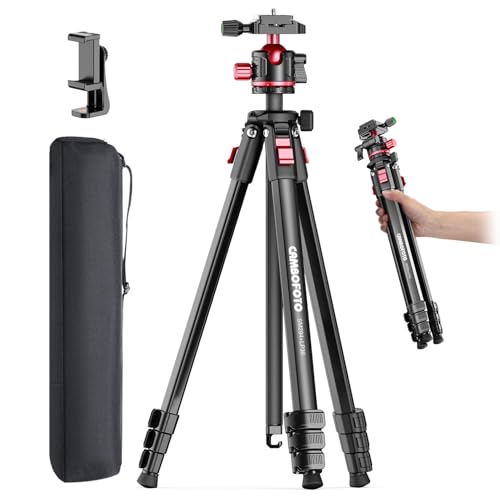
The CAMBOFOTO 68″ tripod combines a compact profile with a tall reach, extending to 68 inches for elevated shots. Its collapsed circumference of 7.08 inches makes it notably portable, and the triangular central column design enhances stability while contributing to a sleek aesthetic. The hexagonal leg sections compress tightly when folded, aiding storage in a travel bag. It supports up to 8.8 pounds, suitable for many DSLR or SLR cameras, small telescopes, or other equipment that benefits from solid grounding. An inverted center column enables macro work at ground level for close-up photography.
K&F CONCEPT 64 Inch Travel Tripod

This K&F CONCEPT model serves as a versatile, lightweight option with a full 64-inch height and a compact 39.5 cm folded size. Weighing about 2.53 pounds with the ball head, it’s easy to carry on hikes or flights. Its 17.6-pound (8 kg) load capacity supports most mid-size DSLRs, lenses, and accessories. A 360-degree ball head enables precise panning, while the quick flip leg locks simplify setup—perfect for travelers who need reliable performance in a compact package.
NEEWER Basics 66.5″ Travel Tripod

The NEEWER BASICS TP12 is an economical option focused on essential features. The aluminum alloy and plastic construction provide stability while keeping weight manageable at about 2.9 pounds. It extends from 20.1 to 66.5 inches and offers invertible center-column support for low-angle and macro shots. The Arca-type dual compatibility QR system broadens compatibility with a variety of camera plates and accessories, which helps travelers adapt to different kits without swapping mounting hardware.
SMALLRIG 71″ Foldable Tripod

The SMALLRIG 71″ tripod delivers robust load capacity (up to 33 pounds) with a foldable aluminum design, making it a strong option for heavier camera bodies or telephoto lenses. It doubles as a monopod, expanding its versatility for hikers and photographers who need quick adaptation in the field. The 360-degree ball head enables precise angle control, and the tripod is designed for 1/4″-20 and 3/8″-16 threaded accessories, ensuring broad compatibility with different gear configurations.
JOILCAN Mini Tripod for Camera

The JOILCAN mini tabletop tripod offers a compact solution for desk or travel use, with a 25-inch maximum height. It holds up to 6.5 pounds and includes a phone/tablet holder, expanding its usability to mobile photography and spotting scope setups. The aluminum construction and non-slip feet provide stability on varied surfaces, while the lightweight form factor makes it easy to slip into a small bag or carry-on pocket for quick, on-the-go shots.
Buying Guide: Key Purchase Considerations
When choosing a lightweight travel tripod, consider several factors to maximize value and performance on the road.
- Load Capacity: Match the tripod’s maximum load to your camera body, lenses, and any accessories (microphones, monitors, etc.). Exceeding the rating risks tip-overs and instability.
- Height and Inverted Columns: Taller travel tripods are helpful for standing shots, while invertible center columns enable ground-level macro work without disassembly.
- Weight and Portability: A lighter tripod is more convenient for long hikes, but ensure it remains sturdy on uneven terrain. Folded size matters for carry-on and bag space.
- Head Type: 360-degree ball heads offer flexible angles, while pan-tilt heads can provide steadier tilts for video. Quick-release QR plates save setup time.
- Material and Build: Aluminum is common for affordability and durability; carbon fiber is lighter but pricier. Look for reinforced joints and reliable locks.
- Versatility: Some models convert to monopods or include smartphone/tablet holders, expanding use beyond photography to videography and mobile content creation.
- Compatibility: Ensure the mounting screw pattern (1/4″-20 or 3/8″-16) works with your camera and accessories; Arca-type plates are widely compatible with various rigs.
- Stability Features: Non-slip feet, wide leg spread, and leg-lock mechanisms influence stability on grass, sand, or rock.
For travelers, balancing portability with performance is essential. A mid-weight tripod with a stable head and a sensible folded size often provides the best mix for most kits, while specialized needs—like macro work or video—may justify a more feature-rich option. Assess your typical shooting scenarios, the heaviest gear you carry, and how often you travel with menagerie of mounts to choose wisely.