Best Light Pollution Filters for DSLR Cameras and Telescopes
Light pollution can wash out the night sky in urban and suburban areas, making it hard to capture vivid deep-sky images. The following filters are designed to reduce city light and improve contrast for DSLR and telescope photography. This article highlights five popular light pollution reduction options, explains how they work, and compares their features to help you choose the right filter set for your needs.
Summary of chosen products:
| Product | Brand | Filter Type | Key Benefit | Link |
|---|---|---|---|---|
| SVBONY CLS EOS-C Clip-on Filter | SVBONY | CLS Clip-on | Reduces city light while preserving nebula emission lines | Amazon |
| ICE 77mm Didymium Filter | Desmond Photographic | Didymium Night Filter | Reduces light pollution with minimal color shift | Amazon |
| SVBONY 1.25″ CLS Filter | SVBONY | CLS | High transmit efficiency for main nebula lines | Amazon |
| SVBONY 2″ CLS Filter | SVBONY | CLS | Broadband city light reduction for larger setups | Amazon |
| SVBONY UHC Filter | SVBONY | UHC | Ultra high contrast for deep-sky targets | Amazon |
The following sections dive into each product, including performance notes and practical considerations. All information reflects the listed features and typical use cases for light pollution reduction in DSLR and telescope imaging.
SVBONY CLS EOS-C Clip-on Filter for Canon DSLRs

The SVBONY CLS EOS-C Clip-on Filter is designed as a clip-on solution for Canon DSLR bodies, enabling convenient removal of city glow while preserving essential nebular emission lines. It employs a durable evaporation coating with ion-assisted deposition to maintain transmission stability across temperature changes. The filter targets major emission lines such as H-alpha (656 nm), OIII (496 and 500 nm), SII (672 nm), and H-beta (486 nm), helping to boost contrast in deep-sky images without introducing heavy color shifts. This makes it suitable for enthusiasts who shoot through a Canon DSLR with an attached telescope or a light-polluted urban sky.
Practical considerations: Clip-on filters preserve mechanical convenience but require compatible camera bodies. The coating system emphasizes throughput stability and scratch resistance, which helps maintain performance over time in field conditions. For best results, pair with longer exposure stacks to amplify nebular details while keeping sky brightness manageable.
ICE 77mm Didymium Filter for Night Sky

The ICE 77mm Didymium filter is designed to reduce light pollution while preserving the natural color balance of the night sky. It blocks the dominant wavelengths associated with urban lighting without drastically altering the spectrum, supporting clearer star fields and more accurate color reproduction in night-sky photography. The filter is built from optical glass suitable for DSLR and telescope applications, providing a practical option for photographers who want a broader, non-clipped reduction of sky glow.
Practical considerations: Didymium-based filters generally offer targeted light pollution control with minimal color cast. They are versatile for stacking with other filters and for use in various focal lengths. Users should assess compatibility with their lens diameter and ensure proper filter threading or clip-on adapters if required.
SVBONY 1.25″ CLS Broadband Filter
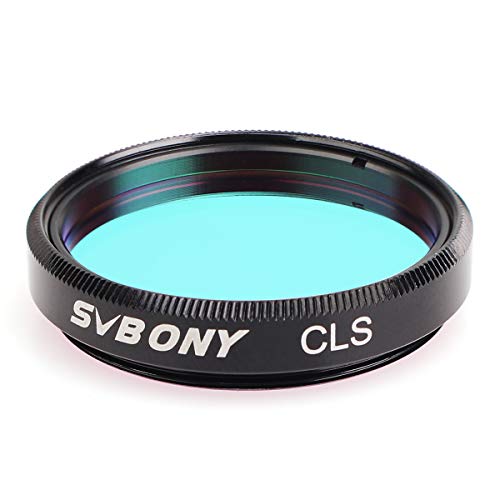
The SVBONY 1.25″ CLS filter uses an ion-assisted evaporation coating to ensure durability and consistent transmission in the pass-band while suppressing off-band light from city lighting. The planetary rotation system provides precise alignment and uniform coating across the filter surface, contributing to reliable performance in both visual and astrophotography applications. A typical outcome is up to 90% transmission within the main nebula emission lines such as H-alpha, OIII, SII, and H-beta, aiding clearer silhouettes of nebulae against light-polluted skies.
Practical considerations: The 1.25″ size is common for many standard eyepieces and adapters. This size suits both small refractors and modified DSLRs. When integrating with a telescope, ensure the filter’s diameter matches the barrel or adapter, and balance the optical train to avoid vignetting in wide-field shots.
SVBONY 2″ CLS Filter for Deep Sky Imaging

SVBONY offers a 2″ CLS broadband filter designed to cut city light pollution and improve contrast in deep-sky imaging. The filter uses ion-assisted deposition coating technology for superior scratch resistance and stable central wavelength across temperature fluctuations. With a high transmission rate in the targeted nebular lines, observers can achieve crisper views of nebulae while reducing skyglow. This option is well-suited for larger aperture setups and binocular-style telescope configurations that benefit from the broader 2″ diameter.
Practical considerations: The 2″ format is compatible with many mid-to-large refractors and reflectors. It may require appropriate adapters or a dedicated 2″ filter wheel for efficient multi-filter workflows. Users should evaluate the exposure strategy, as reduced sky brightness can necessitate longer integrations for faint objects.
SVBONY UHC Filter for Deep Sky Projects
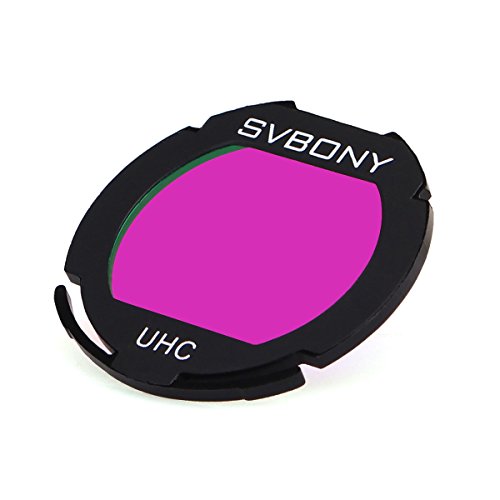
The SVBONY UHC filter offers ultra-high contrast for deep-sky targets by favoring specific emission bands while suppressing most artificial sky glow. Designed for EOS-C clip-on compatibility and DSLR use, the UHC filter aims to enhance contrast in nebula-rich regions and improve the visibility of emission lines critical to deep-sky imaging. Its design focuses on minimizing reflections and maximizing light transmission across the essential lines while sharply reducing stray light.
Practical considerations: UHC filters are especially helpful for planetary nebulae and emission nebulae imaging under light-polluted skies. For best results, plan a tiled or stacked exposure strategy that leverages the filter’s spectral selectivity while avoiding potential color shifts from broad-spectrum atmospheric variations. Compatibility with your camera body and filter threading remains essential.
Buying Guide: Light Pollution Filters for DSLR and Telescope Imaging
- Filter type and target wavelengths: CLS (City Light Suppression) filters are designed to reduce broad city light while preserving key nebular emission lines (H-alpha, OIII, SII, H-beta). UHC filters focus on high-contrast emissions from nebulae. Didymium and specialty filters offer alternative approaches to city glow with varying color fidelity.
- Filter diameter and mount: Ensure compatibility with your system—clip-on (for DSLRs with compatible bodies) or screw-in (1.25″, 2″ filters) formats. Larger diameters suit telescopes with bigger apertures but may require adapters and appropriate filter wheels.
- Coatings and durability: Ion-assisted deposition and multi-layer coatings improve scratch resistance and transmission stability, especially under temperature changes during night sessions. Coatings influence both transmission efficiency and stray light suppression.
- Transmission and color fidelity: High transmission in target emission lines helps preserve signal strength while suppressing sky glow. Some filters may slightly alter color balance; consider whether you’ll color-cbalance in post-processing or in-camera.
- Use case and workflow: Clip-on filters offer quick setup for DSLR imaging, while 2″ and 1.25″ filters suit telescope-based photography and dedicated spectrally selective imaging. Plan stacking and exposure strategies to maximize signal-to-noise ratio for faint targets.
- Maintenance and cleaning: Regular cleaning and safe storage protect coatings. Nano or anti-reflective coatings facilitate easier cleaning in damp night conditions and reduce water/oil beading in the field.
- Budget and availability: A mix of CLS and UHC options across brands provides versatility for different skies. Evaluate whether you need a single-filter setup or a small kit spanning 1.25″ to 2″ diameters for broader compatibility.
- Field testing tips: Compare shots with and without filters under the same sky conditions, using identical exposure settings. Check nebular detail, star color fidelity, and any unintended color casts in post-processing.
- Future-proofing: If you plan to upgrade cameras or telescopes, consider mirrorless bodies or cooled astro cameras that can benefit from optimized spectral filtering for longer total integration times.