Best Light Meter for Camera: Essential Tools for Perfect Exposure
Photographers rely on accurate light readings to ensure correct exposure, color accuracy, and consistent results across scenes. A reliable light meter helps you measure ambient brightness, flash output, and color temperature with precision. Below, we explore five top-rated light meters that suit a range of needs—from studio setups and film photography to plant growth monitoring and field work. Each option offers different features, so you can choose the model that best fits your camera system and shooting style.
Summary of Selected Products
| Product | Brand | Key Use | Notable Feature |
|---|---|---|---|
| Light Meter Digital Illuminance Meter Handheld | URCERI | General photography and ambient measurement | Lux up to 200,000 with 4-digit LCD |
| LightMate AirPro Light Meter Photography | LightNova | Film/Leica and vintage camera work | 35° wide-angle, 3 dials, EV control |
| UNI-T UT383 Light Meter Lux Meter | UNI-T | Photography and plants/indoor lighting | 0–199,900 Lux, FC/Lux, backlit display |
| Sekonic L-308X-U Flashmate Light Meter | Sekonic | Ambient and flash measurement | Reliable ambient/flash in one unit |
| Dr.meter LX1330B Digital Illuminance Meter | Dr.meter | Indoor/outdoor, plant growth | 2x/sec readings, FC/LUX toggle |
URCERI Light Meter With Lux and Temperature
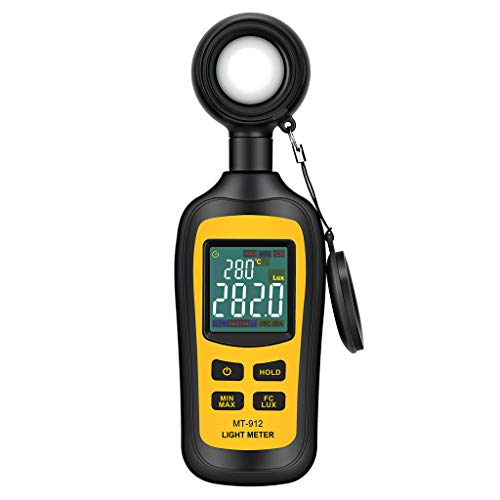
UrceRi’s handheld illuminance meter measures luminosity from 0 to 200,000 Lux and includes ambient temperature. It uses a high-accuracy sensor with a specification of ±3% rdg ±8 dgts under 10,000 Lux and ±4% rdg ±10 dgts beyond that range. A 4-digit color LCD screen displays MIN/Max readings, data hold, auto power off, and a low battery indicator. This model is well-suited for photographers who need a straightforward Lux readout and simple data preservation for field shoots or studio setups.
LightNova LightMate AirPro

LightNova’s LightMate AirPro integrates a 35° wide-angle reflective metering approach tailored for photography and film. It delivers ±0.1EV metering accuracy across ISO 1–3200 and shutter speeds from 60s to 1/8000s. The meter supports Auto modes for Aperture (A) and Shutter (S), as well as Manual and EV modes. Its three independent dials control aperture, ISO, and shutter speed, each with tactile feedback and half-stop or fractional stop options. This design appeals to photographers who favor hands-on control and precise exposure management in film or hybrid digital workflows.
UNI-T UT383 Digital Illuminance Meter

The UNI-T UT383 is a compact digital illuminance meter designed for a wide range of applications. It measures from 0 to 199,900 Lux (and 0 to 18,500 FC) with high accuracy, and presents results on a large 4-digit LCD with backlight. Features include max/min readings, data hold, overload indication, and auto shutdown for power saving. This model is a practical all-purpose device for photographers, horticulture setup, and professionals monitoring lighting levels in workspaces or studios.
Sekonic L-308X-U Flashmate Light Meter

Sekonic’s L-308X-U is a compact, reliable choice for photographers who need accurate ambient and flash readings. It provides measured exposure data in a familiar workflow with a focus on ease of use—ideal for stills and motion work. The unit offers ambient readings across a broad range and features a responsive interface that supports both manual and automatic exposure modes. The Flashmate line is known for dependable performance in studio settings and on-location shoots where swift, precise metering matters.
Dr.meter LX1330B Illuminance Meter

The Dr.meter LX1330B provides rapid readings with a 0–200,000 Lux range. It emphasizes high precision and fast response suitable for indoor/outdoor lighting assessments and plant growth environments. It also offers FC/LUX toggling to match user preferences and measurement contexts. The tool is handy for gardeners and photographers who need quick, continuous light monitoring to optimize exposure and plant health in real-world settings.
Buying Guide: Key Purchase Considerations
When choosing the best light meter for camera work, consider the following factors:
- Measurement range and accuracy: A broad range (0–200,000 Lux) plus high accuracy ensures the meter can handle indoor lighting, sunlight, and studio strobes. Look for manufacturers listing error margins clearly, such as ±3% or better.
- Display and usability: A clear, backlit LCD with time-stamped MIN/MAX or data hold helps you capture readings quickly, especially in low-light or dynamic environments.
- Metering modes: Auto, manual, and EV modes provide flexibility for different shooting styles, from film photography to digital capture with varied ISO and shutter settings.
- Ambient vs. flash capability: Some meters support both ambient light measurement and flash exposure analysis. If you shoot with strobes or on-location lighting, this is essential.
- Additional features: Temperature readings, data logging, rotating sensors, and 180° or wide-angle sensors offer practical benefits for specific setups like horticulture, architecture, or product photography.
- Portability and build: A compact, rugged design is beneficial for fieldwork, while a larger unit may offer a more comfortable interface for studio use.
- Power and battery life: Auto power-off features help preserve batteries on long shoots; check battery type and availability.
- Compatibility with cameras and workflows: Consider whether you need compatibility with film cameras, digital cinema workflows, or integrated with color temperature controls for post-processing.
Comparative Perspectives
For film photographers and those using older cameras, meters with independent aperture, shutter speed, and ISO controls—like the LightMate AirPro—offer tactile feedback and precision exposure control. Photographers working in controlled environments may prefer the straightforward Lux readouts and auto features found in the UNI-T UT383 or Dr.meter LX1330B. In studio or rapid-fire field environments requiring steady readings and reliable flash integration, Sekonic models like the L-308X-U provide a balanced feature set. Finally, gardeners and general-purpose users will appreciate the versatility and compact form factor of meters that toggle between FC and Lux to cover diverse indoor tasks.