Best High Speed Picture Scanner for Quick Photo Digitizing and Archiving
Answering the need for fast, reliable photo scanning, these high-speed picture scanners are ideal for turning boxes of prints into organized digital libraries. They’re best for preserving family memories, batch scanning large photo collections, or digitizing old albums efficiently. The top picks span compact photo-first devices to versatile, document-friendly scanners that also handle photos. Below, compare options and find the right match for your workflow and device ecosystem.
| Product | Best For | Key Benefit |
|---|---|---|
| Epson FastFoto FF-680W | Families and photo archivists | Ultra-fast batch scanning with 36-photo feeder and app-enabled storytelling |
| Plustek Photo Scanner ePhoto Z300 | Traditional photo collectors | Fast 4×6 scans with auto crop/deskew for easy organization |
| ScanSnap iX2500 | Mac or PC users who want cloud-ready scans | Large touchscreen, 45 ppm, auto document feeder, cloud compatibility |
| AMBIR Photo Scanner | Budget-conscious photo fans | Fast 4×6 scans with broad size support and simple upload options |
| ScanSnap iX2400 | One-button simplicity | One-touch scanning with 100-page feeder and reliable performance |
Epson FastFoto FF-680W Wireless High-Speed Duplex Photo and Document Scanner

The Epson FF-680W is designed for high-volume photo capture. It can scan thousands of photos at up to one photo per second at 300 dpi and supports batch scanning of up to 36 photos. This model is best for families and memory archivists who need a dedicated photo-first workflow and a mobile-friendly app for adding voice notes or text to slideshows from a smartphone. A key strength is preserving and sharing a large photo collection with minimal manual handling, while the duplex capability helps you digitize both sides where applicable. A potential limitation is that it is optimized for photo batches rather than mixed-media documents; plan accordingly if you also scan large documents.
Plustek Photo Scanner ePhoto Z300

The Plustek ePhoto Z300 is a fast, compact option for photo-heavy workflows. It supports 3×5, 4×6, 5×7, and 8×10 inch photos, plus letter and A4 documents, with optical resolution up to 600 dpi. Scanning times are roughly 2 seconds for a 4×6 photo and 5 seconds for an 8×10 at 300 dpi. This makes it well-suited for families digitizing a few thousand prints in an afternoon. It is easier than a flatbed for ongoing photo workflows and is explicitly positioned for photo-centric digitization. A caveat: if you regularly scan larger sizes or mixed media, you may want a model with stronger document handling alongside photo modes.
ScanSnap iX2500 Wireless or USB High-Speed Cloud Enabled Scanner

The ScanSnap iX2500 is a robust option for macOS and Windows users who want cloud-connected scanning. It combines a large 5-inch touchscreen, a 100-page auto feeder, and speeds up to 45 pages per minute with two-sided scanning. It supports converting documents and photos to organized digital files with automatic naming and sorting, making it an excellent choice for office-like home workflows. It shines in environments requiring quick access to cloud services and easy sharing. A limitation is that highly specialized photo editing or color correction may require separate software or workflows.
AMBIR Technology Photo Scanner with PICTURESTUDIO

The AMBIR Photo Scanner is a fast, affordable solution for scanning 4×6 photos at 300 dpi in about 3 seconds. It handles a range of sizes from 1×1 to 8×10 inches, and even panoramic photos up to 12 inches. It supports direct uploads from a computer or connected devices, making it convenient for quick sharing. Best for casual photo archiving and family projects, this model provides straightforward, drop-and-scan usability. A potential drawback is that it may lack some advanced document handling features found in higher-end models, so plan for a primarily photo-centric workflow.
ScanSnap iX2500 Photo Edition

The ScanSnap iX2500 Photo Edition variant is tailored for photo-first workflows with a focus on preserving memories. It includes features such as a large touchscreen and the same cloud-enabled capabilities as the standard iX2500, with optimized photo handling. It’s best for users who want seamless photo organization, high-speed scanning, and easy sharing to cloud services. A limitation might be the higher price point relative to entry-level photo scanners, depending on your budget and expected usage.
ScanSnap iX2400 High-Speed Simple One-Touch Scanner
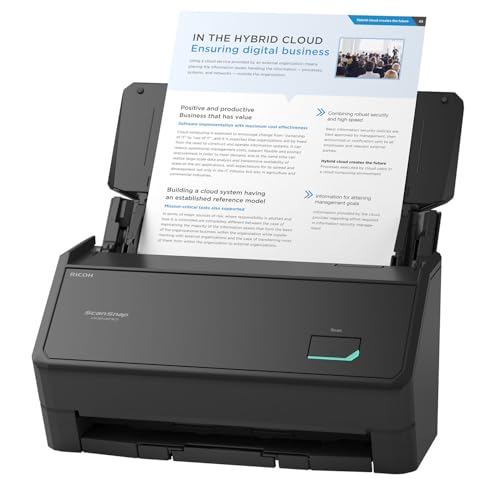
The ScanSnap iX2400 emphasizes one-touch simplicity and reliability. It’s designed for fast, straightforward scanning with a 100-page feeder and up to 45 pages per minute in duplex mode. This model is best for users who want minimal fuss, consistent one-button operation, and solid support for a mix of documents, receipts, and photos. Consider this if you want a dependable, easy-to-use scanner without extra bells and whistles. A caveat is that advanced customization or heavy cloud-integrations may require additional setup or software.
Buying Guide
What should you consider when choosing a high-speed photo scanner?
- Photo vs. mixed media: If you mainly scan photos, prioritize photo-centric devices with fast batch modes and photo enhancement options. If you scan documents too, look for an ADF and duplex capabilities that handle both reliably.
- Scan speed and batch capacity: Larger photo batches benefit from models with fast one-second-per-photo speeds and a high-capacity feeder (e.g., 36 photos). For smaller projects, a compact model may suffice.
- Resolution and color fidelity: A higher optical resolution (300–600 dpi) helps preserve detail, especially for archival photos. Some models offer auto color restoration or red-eye reduction—helpful for faded prints.
- Connectivity and cloud options: USB-C and Wi-Fi are common. Cloud-enabled scanners simplify direct upload to drives, photos apps, and cloud storage, which is convenient for ongoing accessibility.
- Software and organization: Look for automatic file naming, searchable PDFs, and easy export to common formats. A good user interface (touchscreen) reduces setup time.
- Ease of use and maintenance: Consider auto-feed reliability, maintenance needs, and whether the device fits your desk space.
Who should buy these scanners?
- Best for families and memory archivers: Scanners with high batch capacity and photo-centric features, like the Epson FF-680W and the iX2500 Photo Edition, optimize large photo libraries.
- Best for photo collectors with a mixed media workload: Models like the Plustek ePhoto Z300 offer fast photo scans while supporting traditional documents, albeit with a focus on photos.
- Best for budget-conscious setup: AMBIR Photo Scanner provides solid photo support at a lower price point and easy uploads.
- Best for simple, reliable everyday use: The ScanSnap iX2400 emphasizes one-touch operation and dependable performance for a broad range of tasks.
How should you plan your workflow?
- Organize prints by size and date before scanning to minimize manual rework.
- Store digitized files with consistent naming and folder structures to simplify retrieval later.
- Back up digital archives to at least two locations (local and cloud) to improve resilience.
FAQ
- What is the fastest way to digitize a large photo collection? Use a high-volume feeder scanner like the Epson FF-680W or ScanSnap iX2500 to batch scan dozens of photos per minute, then organize with metadata and cloud backups.
- Do these scanners support 8×10 photos? Yes, several models listed (e.g., Plustek ePhoto Z300, AMBIR) handle up to 8×10 inches, with some also accommodating panoramics or larger formats.
- Can I scan documents and photos with one device? Many models offer document feeder modes and photo settings, but some are optimized primarily for photos. Check your primary use case to pick the best fit.
- Is cloud connectivity essential? Cloud options provide easy sharing and access across devices, but USB-only models may still meet strict privacy or local storage needs.
- Will color restoration improve old photos? Auto-restoration features can enhance faded images, but results vary by photo condition and scanner model.
- Are these scanners compatible with Mac and Windows? Most listed models support both platforms and provide software that aids in organizing scanned files across operating systems.