Best High Speed Imaging Cameras for Precision Motion Capture
Looking for a high speed imaging camera to capture fast-moving scenes with minimal distortion? This guide highlights five ready-to-use options across industrial, scientific, and hobbyist use. Each pick targets specific needs such as ultra-fast frame rates, thermal visualization, or 4K output. The best choices are listed with who they’re ideal for and why they stand out, plus a concise buying table to compare core features at a glance.
Selected Products At A Glance
| Product | Best For | Key Speed & Lens |
|---|---|---|
| QILOVE Global Shutter USB Camera – 800P Monochrome Ultra High Speed | Extreme motion analysis, fluid dynamics, ballistics | 120–640fps, CS mount 5–50mm |
| GH192 Thermal Imaging Camera 240×240 | Mechanical maintenance, electrical inspection | Thermal + visible, 25Hz, 6 palettes |
| High Speed USB3.0 0.3MP Color Machine Vision Camera | Industrial automation, rapid triggering | 790fps, USB3.0 |
| IFWATER 4K 60fps High Speed Camera | Close-up microscopy, industrial imaging | 4K60, HDMI/USB3.0, 5–50mm zoom |
| IFWATER Global Shutter 90fps Camera | Sports, 3D printing, fast motion | 90fps, 5–50mm varifocal |
QILOVE Global Shutter USB Camera – 800P Mono High Speed

The QILOVE device uses a global shutter to deliver distortion-free monochrome images at fast frame rates. It is best for scientists and engineers analyzing rapid processes where rolling shutter artifacts must be avoided. The 120–640fps range supports slow-motion review of ballistic trajectories, splashes, and high-speed mechanical events. The included 5–50mm CS-mount lens provides up to 10x optical zoom, enabling flexible field-of-view adjustments. Caution: Monochrome sensors may require controlled lighting for optimal contrast.
GH192 Thermal Imaging Camera 240×240 with Fusion Imaging

The GH192 combines thermal imaging with a visible light camera for fusion analysis. It provides temperature tracking, center-point alarms, and multiple color palettes, making it suitable for electrical, HVAC, or mechanical maintenance inspections where identifying heat patterns is essential. The device supports a 2MP visible camera plus a 240×240 IR sensor and a compact display for on-site assessment. Best for users who need quick thermal insights alongside standard visuals. Limitation: 25Hz frame rate may be slower for certain real-time analyses.
High Speed USB3.0 0.3MP Color Machine Vision Camera

This compact industrial camera emphasizes high transfer speed and a practical software SDK. It supports external triggering and flash, making it suitable for automated inspection lines and rapid capture in controlled environments. The 790fps capability positions it as a strong option for high-speed quality checks. Caution: Needs compatible processing hardware and software development kit integration.
IFWATER 4K 60fps High Speed Camera

The IFWATER 4K camera outputs at 60fps with 4K resolution, supporting USB3.0 and HDMI simultaneously. Its 4K capability plus a 10x zoom lens (5–50mm) makes it ideal for close-up industrial imaging, microscopy, and precision observation in controlled settings. Best for users needing sharp 4K motion capture and flexible viewing distance. Limitation: HDMI+USB streaming may require bandwidth management for some setups.
IFWATER Global Shutter 90fps with 5–50mm Varifocal Lens
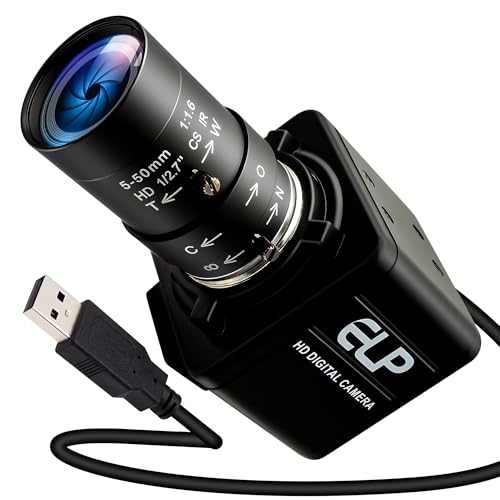
This IFWATER model uses a global shutter at 90fps and a versatile 5–50mm varifocal lens, offering flexible framing for fast sports movements or precise lab monitoring. It’s plug-and-play via UVC, which simplifies setup on laptops, Raspberry Pi, or Android devices. Choose this if you need quick deployment across devices without driver installation. Caution: 90fps may suffice for many uses but not the ultra-fast extremes some scientific setups require.
Buying Guide: Key Considerations for High Speed Imaging Cameras
- Frame rate vs. resolution: Higher fps often comes with lower resolution. Prioritize frame rate for motion analysis and resolution for detail when needed.
- Global shutter vs. rolling shutter: Global shutters reduce distortion with fast motion, while rolling shutters can introduce smear in bright scenes. Select based on typical subjects.
- Sensor type and monochrome vs. color: Monochrome sensors provide higher contrast in low light; color sensors offer true-color observation. Choose per application needs.
- Lens compatibility: Verify mount type (CS, C-mount, etc.) and lens versatility (manual zoom, varifocal) to fit your observation distance.
- Output options: Consider USB, HDMI, or USB3.0 compatibility and whether simultaneous outputs are required for live monitoring or streaming.
- Software and integration: Look for accessible SDKs or driver support for your workflow, including Windows, Linux, macOS, or embedded platforms like Raspberry Pi.
FAQs
- What is the advantage of a global shutter? It captures all pixels simultaneously, avoiding motion blur in fast events.
- Which camera is best for 4K close-up work? The IFWATER 4K 60fps model provides 4K resolution with a 10x zoom lens and HDMI/USB3.0 outputs.
- Do these cameras require special software? Some ships with SDKs or plug-and-play USB UVC compatibility; check your platform requirements.
- Can I use these cameras with Raspberry Pi? Yes, several models offer USB/UVC compatibility and CS or C-mount lenses compatible with Pi setups.
- Is 90fps sufficient for high-speed analysis? For many applications, 90fps is adequate, but ultra-fast dynamics may need higher fps models.
- What should I consider for lighting with high-speed monochrome cameras? Consistent, bright lighting improves contrast and reduces exposure noise in monochrome sensors.