Best High Speed USB Cameras for Ultra‑Fast Motion Capture
For buyers seeking crisp, distortion-free footage of rapid events, these USB cameras with global shutter and high frame rates are ideal. They suit engineers, researchers, and hobbyists analyzing fast processes like projectile motion, mechanical vibrations, or sports swings. The top picks below balance ultra‑high speed, flexible optics, and broad compatibility with Windows, macOS, Linux, and single‑board computers.
| Product | Max Frame Rate | Lens Type | Best For |
|---|---|---|---|
| QILOVE Global Shutter USB Camera – 800P Mono | 640fps | 5-50mm CS (manual focus) | Ballistics, fluid dynamics, high‑speed trials |
| IFWATER Global Shutter 90fps USB Camera | 90fps | 5-50mm Varifocal (10× zoom) | Golf swing analysis, 3D printing monitoring |
| ELP High Speed USB Zoom Camera 1080P/230fps | 230fps | 5-50mm Varied, 10× zoom | Indoor/outdoor motion capture, Jetson Nano projects |
| QILOVE Global Shutter USB Camera – 800P Mono, 2.8-12mm CS | 640fps | 2.8-12mm CS (manual focus) | Farther observation, machine vision trials |
| ELP High Speed USB Camera 1080P/230fps | 230fps | Wide angle M12 lens | Conference spaces, drone navigation, retail setups |
QILOVE Global Shutter USB Camera – 800P Mono

The camera records at adjustable speeds from 120 to 640fps, including 160×120 at 640fps for dramatic slow‑motion analysis. It uses a global shutter to avoid rolling shutter artifacts, delivering smear‑free monochrome images ideal for precise motion tracking. The included 5‑50mm CS lens provides up to 10× optical zoom for flexible observation ranges.
Best for: Ballistics testing, fluid mechanics studies, and high‑speed mechanical experiments where accurate frame‑to‑frame integrity matters. Limitation: Monochrome output means color data isn’t available directly from the sensor; color information may be inferred with external processing if needed.
IFWATER Global Shutter 90fps USB Camera
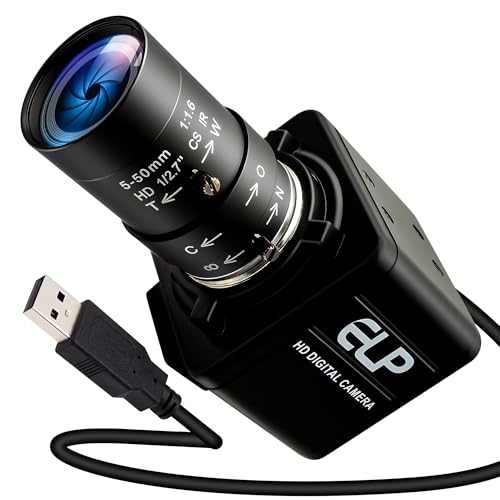
Featuring a 90fps high‑speed capture with a 5‑50mm varifocal lens offering up to 10× zoom, this camera emphasizes quick setup via UVC plug‑and‑play compatibility. It’s well suited for golf swing analysis, industrial monitoring, and 3D printer workflow observation.
Best for: Quick deployments on laptops or Raspberry Pi, where straightforward USB video capture is preferred. Caution: The 90fps ceiling may be limiting for the most extreme slow‑motion needs.
ELP High Speed USB Zoom Camera – 1080P/230fps

This camera delivers up to 230fps at 1080p and 60fps at 4K, with 12-megapixel image capability for stills. It uses a 5‑50mm variable focus lens with 10× manual zoom, enabling clear framing without lens swaps. It supports YUY2 and MJPEG formats for flexible video encoding.
Best for: High‑speed indoor applications requiring sharp zoom control and reliable video formats. Limitation: May require sufficient lighting to maximize ultra‑high‑speed performance.
QILOVE Global Shutter USB Camera – 800P Mono, 2.8-12mm CS

This variant sticks with 800P mono output and 120–640fps recording with a 2.8‑12mm CS mount lens offering 4× optical zoom. It emphasizes flexible focal length for distant or close‑up high‑speed observation while preserving global shutter quality.
Best for: Farther observation when you need adjustable focal length without changing lenses. Limitation: The 2.8–12mm range may be narrower for some long‑range views compared to 5–50mm solutions.
ELP High Speed USB Camera – 1080P/230fps

This model offers 1080p at 230fps and a wide 88° field of view via a wide‑angle M12 lens. It’s designed for versatile environments such as conference spaces, retail environments, or drone navigation where broad scene coverage matters.
Best for: Applications needing a broad view in fast action contexts. Limitation: Wide angle can introduce slight edge distortion if not accounted for in post‑processing.
Buying Guide: Key Factors to Consider
- Global Shutter vs Rolling Shutter: Global shutter sensors capture all image lines simultaneously, eliminating skew during fast motion and providing distortion‑free results. This is essential for precise motion analysis.
- Frame Rate vs Resolution: Higher frame rates deliver smoother slow‑motion playback, but may limit resolution depending on the sensor. Prioritize frame rate for extremely fast processes; increase resolution for detailed spatial analysis when motion is moderately fast.
- Lens and Mount Compatibility: CS and C‑mount options offer different mounting versatility. Varifocal lenses (5‑50mm) provide flexible framing; ensure the mount matches your setup (CS or M12, etc.).
- Interface and Power: USB cameras with UVC plug‑and‑play simplify setup on multiple devices. Check whether power is bus‑powered or requires an external supply for longer recording sessions.
- Low‑Light Performance: Monochrome sensors often deliver better contrast and sensitivity in dim environments, aiding high‑speed capture where light is limited.
- Software and Output Formats: Support for MJPEG and YUY2 can influence compatibility with your analysis pipeline. Consider whether real‑time streaming or offline processing is your goal.
- Portability and Setup: Cameras with compact bodies and modular lenses suit field tests or lab environments with limited space.
Frequently Asked Questions
- What is a global shutter, and why is it important for high‑speed capture?
A global shutter captures all pixels in a frame at the same instant, preventing rolling shutter artifacts during fast motion, which is essential for accurate analysis of rapid events. - Do these cameras require specialized software?
Many models support standard USB video protocols (UVC) and work with common video capture software, though some features may be unlocked by vendor software. - Can I use these cameras with a Raspberry Pi?
Several listed models advertise compatibility with Raspberry Pi, Linux, macOS, and Windows, often via USB interfaces and standard drivers. - What lens options are available?
Most cameras come with or support 5–50mm varifocal lenses, with CS or M12 mounts, enabling adjustable focal length and focus for different distances. - Which camera is best for indoor vs outdoor environments?
Cameras with higher frame rates and robust low‑light performance are preferable indoors. Wider FOV lenses help with outdoor scenes, but may require calibration for distortion. - Are higher frame rates always better?
Higher frame rates improve slow‑motion fidelity but may reduce available light and require better illumination to maintain image quality.