Best High Resolution Thermal Cameras for Precise Inspections in 2026
The best high resolution thermal camera picks deliver clear detail, fast refresh rates, and practical features for home, electrical, and HVAC inspections. This guide targets buyers who want sharp thermal images, reliable software or data capture, and devices that work well with smartphones or PCs. Below are five top options, with who they’re best for and why each stands out. A quick summary table follows to compare key specs at a glance.
| Product | Resolution (IR) | Display | Best For |
|---|---|---|---|
| TOPDON TC004 Mini | 128×128 (enhanced to 240×240) | — | Field technicians needing compact hardware with strong detail |
| TOPDON TC004 3.5″ | 256×192 (512×384 with TISR) | 3.5″ | Pro inspections with larger viewing area |
| Thermal Master | 512×384 (X³IR) | 3.5″ IPS | High-detail surveys with PC/WA integration |
| HF96 Thermal Camera | 240×240 (live 240×240 via super resolution) | — | AI-assisted scene detection for quick sweeps |
| FOXWELL RT280 | 240×180 (TISR to 240×180) | 2.8″ | Budget-friendly basic inspections with PC analysis |
TOPDON TC004 Mini Thermal Imaging Camera

The TC004 Mini blends a 128×128 infrared core with an enhanced 240×240 resolution via TISR for crisper details. Its 40° x 30° field of view and 25Hz refresh deliver smooth imagery suitable for home, electrical, and machinery diagnostics. It supports temperature monitoring from -4°F to 842°F (-20°C to 450°C) with ±3.6°F/2% accuracy and offers five color palettes for work-specific visibility.
Best for: technicians and homeowners who need a compact, affordable option with reliable alerting and on-device photo capture. Choose this if you want a small form factor that still delivers solid detail and simple temp alerts.
Caution: While compact, it has a smaller native IR resolution; use enhanced mode when higher detail is critical to avoid missing subtle hotspots.
TOPDON TC004 3.5″ Thermal Imaging Camera

This model expands to a 3.5-inch display and upgrades to 512×384 thermal resolution via TISR, delivering crisper images for sharper hotspot identification. The built-in red laser pointer helps align the temperature reading area with real targets, improving first-pass accuracy during electrical or mechanical inspections.
Best for: professionals who need a larger viewing area on the device and sharper imagery for complex environments. Compare this if you regularly analyze fine temperature variations and benefit from dedicated aiming assist.
Caution: Heftier than the mini, which may affect portability in tight spaces.
Thermal Master Handheld Thermal Camera

Thermal Master offers 512×384 IR resolution with X³IR processing and a 3.5″ IPS display for vivid visuals. It supports up to 25Hz and a 40mK sensitivity for rapid, precise inspections. Features include six measurement points, automatic WiFi to smartphones or PCs, and onboard audio notes to help with reporting.
Best for: users requiring high-resolution thermal data with versatile data transfer and on-device documentation. Choose this when PC or mobile connection to review data in real-time is beneficial.
Caution: Data transfer and software features rely on external devices; ensure compatibility with your chosen workflow.
HF96 Thermal Camera With AI Scene Detection

HF96 integrates AI-driven IntellFault technology for automated scene recognition, filtering for leaks and insulation gaps. It combines a thermometer, laser pointer, and heatmap visualization in one tool. Live super resolution enhances imagery to 240×240 in real time, with a 25Hz refresh and sub-50mK sensitivity for subtle hotspot detection.
Best for: HVAC and building inspection professionals who want quick, AI-assisted scanning and clear visualizations. Choose this if you value automated scene analysis to speed up field decisions.
Caution: Firmware updates are required for full AI features; ensure you can access the manufacturer’s updates when needed.
TOPDON TC002C Duo Thermal Camera

The TC002C Duo pairs a thermal camera with universal USB-C connectivity to mobile and desktop devices, delivering 256×192 IR resolution enhanced to 512×384 via TISR. It supports a broad temp range (-4°F to 1022°F) with 25Hz refresh and 40mK sensitivity, and includes standard photo and video capture. It’s designed for seamless integration with iOS, Android, and Windows devices using USB-C or Lightning adapters.
Best for: users who want plug-and-play compatibility across multiple devices without standalone batteries or wireless pairing. Choose this if device compatibility and easy sharing of results matter most.
Caution: Not universally compatible with all Mac/Android versions; verify device compatibility before purchase.
TOPDON TC001 Max Dual-Lens Thermal Camera

The TC001 Max uses dual-lens imaging to combine infrared with visible-light detail, enhancing contour clarity and anomaly identification. It supports broad device compatibility with USB-C and Lightning adapters for plug-and-play use, avoiding the need to remove most phone cases. It uses TOPDON’s TISR tech to boost thermal resolution to 512×384, at a 25Hz refresh rate and high sensitivity.
Best for: inspectors who need quick cross-referencing between thermal and visible imagery on smartphones or tablets. Choose this if you want sharper outlines and easier context for heat-related issues.
Caution: It relies on compatible adapters and may require occasional software updates to maintain smooth operation.
TOPDON TC005 3.5″ Dual-Lens Thermal Camera
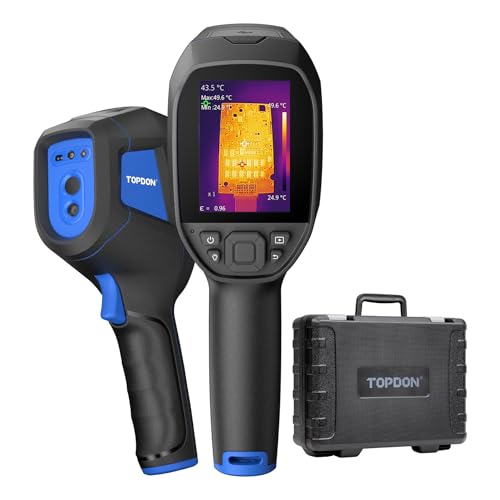
The TC005 combines dual-lens imaging with a 3.5-inch display and 512×384 IR resolution via TISR, plus a built-in laser distance meter up to 4 meters for precise targeting. It includes 64 GB of internal storage for comprehensive documentation and a handheld form factor designed for field use with an eight-hour battery life.
Best for: professionals who require precise targeting, robust on-device storage, and a larger display for on-site reporting. Choose this if you routinely generate detailed thermal reports in the field.
Caution: Higher feature set means higher price; ensure the extra capabilities align with your workflow needs.
Buying Guide: How To Choose A High Resolution Thermal Camera
- What resolution matters most? Look for cameras offering at least 256×192 IR resolution with upscaling (TISR) to 512×384 for sharper detail in critical zones.
- Refresh rate and sensitivity: A 25Hz or higher refresh rate and sub-50mK NETD enable smoother video and finer hotspot detection during dynamic inspections.
- Display size and ergonomics: Larger displays help interpret complex scenes; consider handheld vs. compact compact models for field mobility.
- Connectivity and data workflow: USB-C, Lightning, or Wi-Fi options affect how easily you transfer photos/videos to PCs or mobile devices for reporting.
- Built-in features: AI scene detection, laser targeting, multiple palettes, and photo/video capture capabilities can streamline diagnostics and documentation.
- Field vs. professional use: If you frequently generate formal reports, prioritize devices with robust storage, easy export, and accurate measurement tools.
- Balance of cost and capability: Higher-res models with dual lenses or AI features typically offer more value for professional workloads; assess your primary inspection scenarios to avoid overpaying for features you won’t use.
Frequently Asked Questions
- What is TISR in thermal cameras?
– TISR stands for Image Super Resolution technology. It enhances a camera’s thermal image from a lower baseline (e.g., 256×192) to a higher effective resolution (e.g., 512×384) for crisper details. - Why would I need a dual-lens thermal camera?
– Dual-lens models combine infrared imaging with visible-light capture to provide sharper outlines and easier correlation with real-world targets, improving diagnosis accuracy. - Is a larger display always better?
– A larger display helps in busy inspection environments, but it may reduce portability. Choose based on how often you view images on-device vs. on a PC. - Can thermal cameras connect to my phone or PC easily?
– Many models support USB-C or Lightning adapters and Wi‑Fi for wireless transfer; verify compatibility with your devices before purchasing. - Do I need AI features for typical home inspections?
– AI scene detection can speed up screening, but for straightforward tasks, essential features (high resolution, good sensitivity, and reliable temperature measurement) are often sufficient. - Are these cameras suitable for electrical or HVAC work?
– Yes, high-resolution IR imagery helps identify hotspots, insulation gaps, and mechanical faults, making them suitable for electrical, HVAC, and building diagnostics.