Best Heavy Duty Boom Pole for Studio and on-Set Use
When you need reliable, rigid support for directional mics in demanding environments, a heavy duty boom pole is essential. This guide highlights five top-rated, all-metal options designed for film production, broadcasting, and live sound. Each product emphasizes stability, durable construction, and versatile reach to ensure clean, uninterrupted recordings in studios, on location, or in field productions.
| Product | Key Benefit | Approximate Height / Reach |
|---|---|---|
| AXCESSABLES AXCMB-T Heavy Duty Microphone Boom Stand | All-metal construction; extra-stable tripod base | 47″ to 80.5″ (boom 30.5″ to 65.5″) |
| AxcessAbles Heavy Duty Microphone Boom Stand (80″ Height) | Lead-insert weighted base; smooth 180° wheel joint | 50″ to 82″ height; 4’5″ to 8’2″ boom |
| NEEWER Pro 100% Stainless Steel C Stand With Boom Arm | Sturdy all-metal build with long reach | Max height 10.5 ft |
| InnoGear Microphone Stand, Tripod Boom Arm | Heavy-duty tripod; 360° boom rotation | 28.1″ to 89.8″ height |
| NEEWER Upgraded Microphone Boom Pole, MS-300C | Telescopic carbon fiber for light weight and strength | 2.4 ft to 9.8 ft |
The selections emphasize stability, durable materials, and flexible reach to cover overhead, room-wide, and close-mic scenarios. All options are suitable for shotgun mics and other professional mics, ensuring secure positioning and consistent performance in challenging environments.
AXCESSABLES AXCMB-T Heavy Duty Microphone Boom Stand

The AXCMB-T offers superior stability with a heavy-duty tripod base reinforced by lead inserts, reducing the need for sandbags. It is significantly heavier than many competitors, keeping gear secure during use. Its height adjusts from 3 ft 9″ to 6 ft 7″, while the boom extends from 2 ft 6″ to 5 ft 6″, supporting a wide range of applications from film shoots to music recording. Built with all-metal construction, it emphasizes durability with metal tubes and joints; only the knobs are plastic.
AxcessAbles Heavy Duty Microphone Boom Stand

This stand uses a lead-insert weighted tripod base to maximize stability, reducing the need for sandbags. It features a versatile 180-degree wheel joint that lets you rotate the boom in any direction and lock it into place with a tightening handle. The stand covers a height range from 4 ft 2″ to 6 ft 10″, with a boom length from 4 ft 5″ to 8 ft 2″. It is designed with a robust all-metal construction for demanding environments such as film sets and studio work.
NEEWER Pro 100% Stainless Steel C Stand With Boom Arm
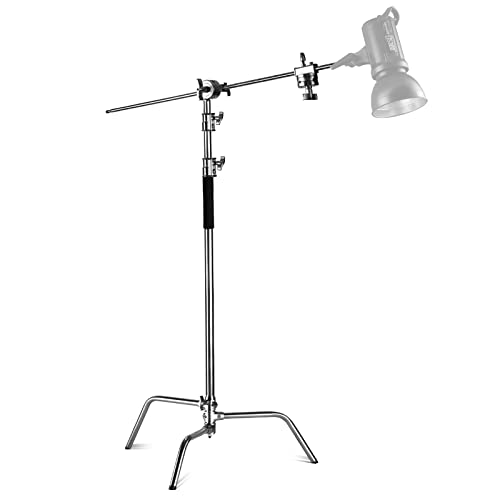
NEEWER’s 100% stainless steel C stand with a boom arm delivers pure metal strength and a high load capacity, ideal for overhead mic setups, monolights, softboxes, and reflectors in studios or on-location shoots. The design prioritizes durability, with comments highlighting the extended height and strong jointing capabilities for precise mic placement. Note that proper balance is essential when adjusting angles to avoid stressing joints.
InnoGear Microphone Stand With Boom Arm

InnoGear’s tripod-based stand emphasizes stability with sturdy steel poles and a heavy base, making it suitable for both indoor and outdoor use. The boom arm adjusts from 16″ to 30″ and can rotate 360° horizontally and 180° vertically. The height range spans from 28.1″ to 89.8″, offering flexibility for voice-over, singing, podcasts, and instrument miking. The design supports quick angle changes via accessible knobs and a detachable boom for straight mic operation.
NEEWER Upgraded Microphone Boom Pole, MS-300C

NEEWER’s MS-300C is a lightweight yet strong telescopic carbon fiber boom pole with five sections. It scales from 2.4 ft (74.5 cm) to 9.8 ft (300 cm), making it ideal for in-frame miking while keeping the mic out of shot. It ships with shoulder strap and storage bag for easy transport, and supports a maximum load of about 4.4 lb (2 kg). Quick twist locks ensure secure section fastening for reliable, on-the-go use.
Buying Guide: Key Considerations For Heavy Duty Boom Poles
- Construction material: All-metal poles (steel, aluminum) offer maximum durability and stability for rugged environments, while carbon fiber provides high strength-to-weight with lighter carry but can be pricier.
- Base stability: Weighted tripods and wide stance minimize tip-overs when handling tall booms or heavy microphones. Look for lead-insert bases or reinforced tripods for added security.
- Reach and height: Consider the maximum boom length and the adjustable height range to fit your typical mic positions, whether overhead, eye level, or far-field.
- Joint design and articulation: 180° or 360° rotation capabilities enable flexible aiming. Locking mechanisms should be easy to engage and secure without slippage.
- Compatibility: Ensure the stand’s clamp or end fittings match your mic clip or shock mount size (commonly 1/4″, 3/8″, or 5/8″ threads) and accessories such as windshields or clips.
- Portability: Telescoping or collapsible sections improve transport, especially for field shoots. A carrying bag or strap adds convenience for on-location work.
- Weight handling: Check the maximum load rating to ensure your mic and shock mount are supported without strain on joints or bases.
- Maintenance: All-metal joints are generally easier to maintain; avoid plastic components in critical joints for heavy-use scenarios.
- Cost-to-performance: Heavy-duty stands typically cost more, but offer longer service life and better stability under demanding conditions. Balance budget with expected usage.
- Environmental considerations: Stainless steel stands resist corrosion and humidity, suitable for outdoor shoots; carbon fiber components excel in light portability but may require more care at extreme temperatures.
These considerations help compare options across the listed products: AXCMB-T and the AxcessAbles heavy duty options emphasize stability and metal construction; NEEWER products highlight long reach and robust stands suitable for overhead and studio use; InnoGear and TENBEST offer mix-and-match versatility for various recording and lighting setups. For best results, align your choice with typical mic weights, on-location vs. studio needs, and the preferred balance between portability and rigidity.