Best EF Lenses for Portraits to Elevate Your Canon Photo Setup
The right EF lens can transform portrait photography, delivering flattering skin tones, creamy bokeh, and sharp subject detail. This guide highlights five popular Canon EF and EF-mount lenses commonly used for portraits, examining their strengths, typical use cases, and key features. Whether you shoot in natural light or studio settings, these lenses offer varied focal lengths, max apertures, and focusing experiences to suit different styles and cameras.
Summary Table of Chosen Products
| Product | Brand | Focal Length | Aperture | Notes |
|---|---|---|---|---|
| Canon EF 50mm f/1.8 STM Lens | Canon | 50mm | f/1.8 | Great all-around portrait lens with smooth bokeh |
| EF 85mm f1.8 Portrait Lens – Lightdow | Lightdow | 85mm | f/1.8 | Manual focus for precise control and unique character |
| Meike 85mm f1.8 | Meike | 85mm | f/1.8 | AF option with solid build and sharpness |
| 85mm f1.8 Portrait Lens – JINTU | JINTU | 85mm | f/1.8 | Manual focus with robust metal build |
| BENOISON 85mm f1.8 Portrait Lens | BENOISON | 85mm | f/1.8 | Manual focus; versatile for creative portraits |
Canon EF 50mm f/1.8 STM Lens

With a 50mm focal length and a bright f/1.8 maximum aperture, this Canon prime is a staple for portraits, event shoots, and low-light scenarios. Its compact design suits street shoots as well, while the 40º horizontal, 27º vertical, and 46º diagonal angles provide flexible framing. The minimum focusing distance of 0.35 meters enables tighter head-and-shoulders compositions, and the 0.21x maximum magnification supports selective focus in post-processing.
EF 85mm f1.8 Portrait Lens – Lightdow

This fully manual 85mm lens emphasizes precise focus control and a distinctive creative process. It features a wide f/1.8 aperture for shallow depth of field and rich bokeh. It is designed for photographers who prefer full manual operation and a stable, durable build. The lens presents a smoother background blur and a classic portrait look, with a caution about manual-only operation and camera readiness for non-electronic lenses.
Meike 85mm f1.8

The Meike 85mm f/1.8 is a versatile portrait lens offering a bright aperture and a sharp image profile. Its 9-element-in-6-group construction helps minimize aberrations, delivering clear subject rendering with appealing background separation. The lens supports excellent bokeh and a well-proportioned field of view for head-and-shoulder and half-body portraits, with a robust build suitable for everyday use.
85mm f1.8 Portrait Lens – BENOISON
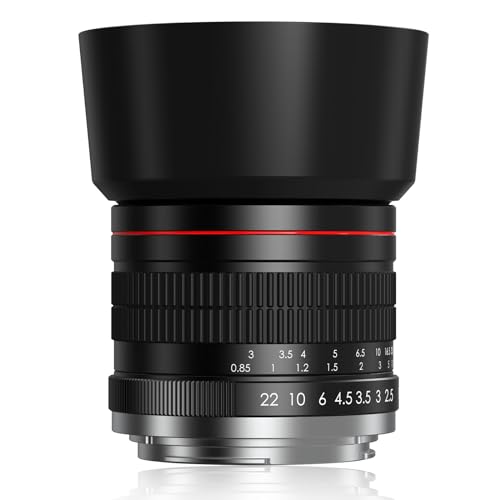
Note: This is a manual focus lens designed for EF-mount cameras. It emphasizes a classic 85mm portrait perspective with an f/1.8 aperture and a robust, all-metal construction. Photographers benefit from deliberate focusing and the lens’s ability to render subject detail with a soft, artistic background blur for studio or outdoor portraits.
Buying Guide: Key Considerations for Portrait Lenses
Focal length and perspective greatly influence portrait look. Shorter primes (50mm) offer natural perspective with wider environments, while 85mm lenses provide flattering compression and stronger background separation, ideal for head-and-shoulders shots. Manual focus options can encourage precise focusing and creative control, though they may require more practice. Autofocus variants deliver speed and convenience in dynamic shoots. Aperture choices impact bokeh and light gathering; faster lenses create creamy backgrounds and work better in low light. Build quality matters for field work, especially when shooting on location or in studios.
Sensor size and working distance affect composition. On full-frame bodies, 50mm to 85mm primes are common choices for professional portraits. For crop-sensor Canon cameras, 85mm on EF-S or similar can still yield flattering results, particularly when distance to the subject is managed. Consider weight and balance for longer sessions, as heavier lenses can cause fatigue or instability. Compatibility matters; ensure you’re selecting EF or EF-mount lenses appropriate for your specific Canon model and any adapters you might use.
Autofocus vs. manual focus lenses: AF lenses save time in fast-paced shoots, but MF lenses can deliver deliberate, technique-driven results with precise control of focus plane. For studio portraits with consistent lighting, MF lenses paired with a tripod can achieve repeatable results. For weddings or quick sessions, AF lenses can help you keep up with movement and expressions. Finally, assess the lens’s distortion, color rendition, and longitudinal chromatic aberration, especially for close-range portraits and skin tones.
Budget and future-proofing: entry-level primes like the 50mm f/1.8 generally deliver strong image quality at a lower cost, making them popular starting points. Higher-end 85mm or specialty lenses may offer improved bokeh quality, sharper edges, and better performance in challenging lighting. If you anticipate evolving your portrait work, consider a versatile 50mm and a fast 85mm pair to cover a broad range of shooting scenarios.