Best Photo Scanning Solutions for Preserving Memories in Digital Form
Looking for a reliable way to digitize printed photos and film? This guide highlights five top Amazon picks designed to convert pictures, negatives, and slides into high-quality digital files. Each option targets different needs—from fast batch scanning to standalone, portable digitization—so you can choose the best fit for your collection, budget, and workflow. The buyer profiles below help you match features to use cases, whether you’re archiving family albums, creating digital slideshows, or preserving vintage film.
Below is a quick comparison of the featured products to help you decide at a glance:
| Product | Best For | Key Benefit |
|---|---|---|
| Epson FastFoto FF-680W | Large photo collections, seniors and researchers | High-speed batch scanning with 8×10 photos support |
| KODAK Slide N SCAN | Film negatives and slides | Built-in LCD for immediate review and editing |
| DigitPro Photo Scanner | All-in-one standalone scanning | 5″ LCD, no computer required |
| AMBIR Photo Scanner with Cleaning Kit | Quick digitization with restoration workflow | Auto crop & deskew support |
| MUNBYN Portable Scanner | On-the-go scanning | Ultra-portable wand scanner with USB transfer |
Epson FastFoto FF-680W Wireless High-Speed Duplex Scanner

The Epson FF-680W is designed for fast, high-volume photo digitization. It can scan thousands of photos quickly at 300 dpi and supports batch scanning of up to 36 photos at once. This makes it a strong choice for large photo collections, families archiving decades of prints, or researchers cataloging images. It also supports postcards and photos up to 8 x 10 inches. A notable feature is the ability to use the Epson FastFoto app to add voice and text overlays or create slideshows from a smartphone, aiding in sharing and preserving context for generations.
Best for: households with extensive photo archives and users who want fast batch capability with the option to annotate images via a mobile app. Better for those who value speed and batch processing over ultra-high optical fidelity for every single frame. Caution: The device excels with physical photos; small size photos might require careful placement to maximize batch throughput.
KODAK Slide N SCAN Film & Slide Scanner

The Kodak Slide N Scan is built for film and slide digitization. It accommodates 135, 126, and 110 negatives and slides, with a 5-inch LCD display that provides instant previews and editing guidance. This model is ideal for users who want to review and adjust images directly on the device before exporting to a digital file or SD card. It’s a practical choice for families with a legacy of film and a desire to instantly reframe memories for modern viewing.
Best for: film and slide enthusiasts who want a standalone scanner with a built-in screen for quick previewing and editing. Choose this if you prefer a single device that handles multiple film formats without needing a separate computer. Limitation: The SD card is not included, so you’ll need to provide your own storage solution.
DigitPro Photo Scanner With Film Digitizer
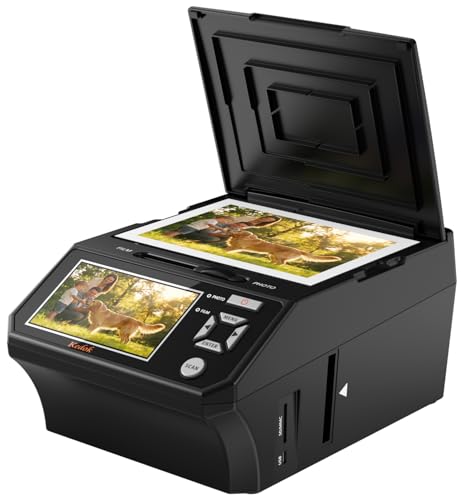
The DigitPro standalone unit handles 35mm, 110, and 135 negatives, slides, and printed photos with a built-in 5-inch LCD for direct viewing. Its “One-Touch” operation makes it approachable for parents and grandparents who want a simple, no-software experience. The device is positioned as an all-in-one solution for households digitizing mixed media without a computer, ensuring that older photos and film can be transformed into shareable digital files quickly.
Best for: users seeking a compact, easy-to-use standalone scanner that supports multiple formats. Choose this if you want a straightforward, software-free workflow. Limitation: It may not offer the same depth of editing options as software-based workflows on a PC or Mac.
AMBIR Photo Scanner With Cleaning Kit Bundle

The AMBIR package focuses on speed, with the ability to scan photos in seconds. It supports 3″ x 5″ to 8″ x 10″ prints and smaller formats up to panoramic images, with 300 or 600 DPI scanning options for archival-quality results. The kit includes a cleaning option to help maintain scanning quality and reduce dust artifacts. It’s a practical choice for families that want a high-speed entry-level workflow with tangible restoration support.
Best for: households that require quick digitization across multiple photo sizes and want higher DPI options for preservation. Choose this if you value speed and a bundled maintenance kit. Limitation: The absence of explicit software details means you may rely on bundled tools for organizing and editing rather than a full software suite.
MUNBYN Portable Scanner

The MUNBYN portable scanner is a wand-style device designed for on-the-go digitization. It scans at up to 900 DPI and works with A4-sized documents, photos, and other flat media. It’s powered by USB transfer to a PC or laptop and does not require driver installation. This makes it ideal for travelers, students, and professionals who need quick captures outside a traditional desk setup. A notable caveat is that wand scanners may require careful handling to avoid light-textured distortion on glossy photos.
Best for: users who need a compact, battery-friendly solution for occasional photo and document scanning away from a computer. Choose this if you value portability over high-volume batch processing. Limitation: Requires USB connection and may demand careful handling for best results with glossy prints.
Buying Guide
What should you consider when selecting a photo scanner?
- Scanning speed vs. batch capacity: Larger collections benefit from fast, batch-capable models like the Epson FF-680W, while smaller, mixed-media archives may be handled by standalone scanners with quick one-pass workflows.
- Supported media: Ensure the device supports the formats you own—prints up to 8 x 10 inches, negatives, slides, panoramic photos, or 35mm and 110 film.
- Display and editing: Built-in LCDs help preview and edit without a PC; dedicated software can provide more granularity for color correction and restoration.
- Portability: For off-site digitization, consider handheld or compact desktop options; weigh battery vs. USB-powered operation.
- Storage and transfer: Check included memory, SD card compatibility, and PC/Mac transfer options to fit your workflow.
FAQ
- What is the main benefit of a high-speed photo scanner?
It reduces time required to digitize large photo collections by processing many photos in a single pass.
- Do I need a computer to use these scanners?
Some models are standalone with built-in displays, while others require a PC or mobile app for full functionality.
- Can these scanners preserve old negatives and slides?
Yes, several models explicitly support negatives and slides, often with adapters or dedicated trays.
- Is 600 DPI sufficient for archival purposes?
For many photo preservation needs, 600 DPI provides a good balance of file size and detail; higher resolutions are possible on certain models.
- Are bundled cleaning kits important?
Maintenance tools help keep glass and optics clear, reducing dust and artifacts during scanning.
- What should I expect from a portable scanner?
Portables offer convenience and flexibility but may deliver lower batch throughput and require careful handling for glossy photos.