Best Digital Eyepiece for Microscope: Top Picks for 2026
Modern digital eyepieces transform traditional microscopes into connected viewing and recording devices. The right model offers high-resolution live view, straightforward installation, and reliable integration with apps or PCs. This guide highlights five strong options, focusing on ease of use, compatibility, and practical features for researchers, educators, and hobbyists.
Product Overview | This table summarizes the five highlighted digital eyepieces:
| Product | Brand | Key Benefit | Link |
|---|---|---|---|
| 64GB Digital Eyepiece Telescope Camera | Unalace | 2K video, 16MP photos, WiFi streaming | Amazon |
| Digital Eyepiece 1080P FHD | AOMEKIE | Multiple adapters, cross-platform viewing | Amazon |
| Electronic Eyepiece 2MP | FTVOGUE | Two modes, clear imaging, LED illumination | Amazon |
| MD300A 3MP USB Eyepiece | AmScope | Windows/Linux/macOS compatibility, stitching and measurement | Amazon |
| MD1200A 12MP USB Eyepiece | AmScope | Higher resolution, advanced software features | Amazon |
Choosing the right digital eyepiece involves evaluating image quality, compatibility with existing microscopes, software support, and ease of use. The selections below offer a range of resolutions, from 2K video to 12MP stills, and varied connectivity options—from built-in WiFi to USB-C streaming. Each entry includes practical installation notes and typical use cases to help you compare at a glance.
Unalace 64GB Digital Eyepiece: 2K Video & WiFi

The Unalace eyepiece installs easily on any microscope or telescope with a 25–50mm eyepiece. No tools are required—rotate to secure for quick setup. The built-in WiFi hotspot enables direct smartphone connection without internet access, allowing live HD streaming and remote control via the companion app. Capture high-quality imagery with a 2K video pipeline and up to 16MP stills, with options for time-lapse and timed recording to simplify long observations. This model suits classroom demonstrations and field work where quick sharing matters.
Compatibility is broad due to its universal 25–50mm fit, and the offline control capability ensures reliability in locations with limited network access. Practical use cases include field observations, night-sky imaging, and rapid specimen screening. Battery life is supported by internal power with options for continuous operation during extended sessions. This option emphasizes hands-off operation with timed recording modes to minimize manual interaction during observations.
AOMEKIE Digital Eyepiece: 1080P With Adapters
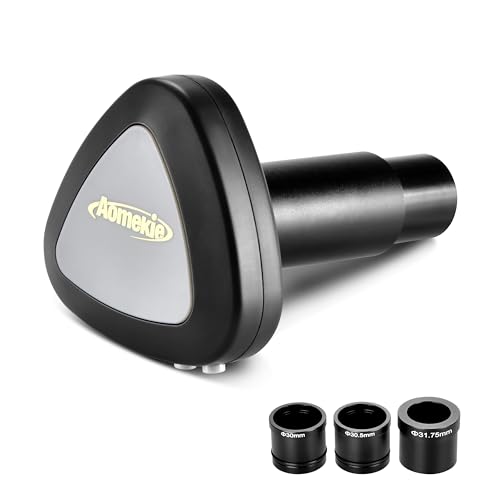
The AOMEKIE eyepiece ships with three adapter rings to fit astronomical telescopes and microscopes, supporting iOS, Android, and PC connectivity. It streams live telescope views to a laptop or PC via WiFi, enabling hands-free observation while freeing the eyes for instrument handling. A built-in 800 mAh battery allows 60–90 minutes of use after a full charge, with optional direct power supply to extend sessions. This model prioritizes cross-device compatibility and extended operational time, ideal for lectures or lab demonstrations where external display connections are valuable.
Users should consider the balance between portability and battery life. If you require longer sessions away from power, plan for external power or alternate power options. The WiFi streaming feature supports quick sharing of observations to students or collaborators, aiding collaborative experiments and remote teaching. The included adapters make it flexible for a wide range of microscope and telescope configurations.
FTVOGUE Electronic Eyepiece: 2MP, Two Modes

FTVOGUE presents a compact digital eyepiece with a 1/3 inch sensor, delivering progressive scanning and high sensitivity in low light. It offers two operation modes for white balance, exposure, and a robust stainless-steel case for durability. The 960 TV line-like hardware and a clear imaging pipeline enable refined color reproduction and reduced color fringing, making it suitable for basic biology labs and field work where lighting conditions vary. It defaults to PAL, ensuring broad compatibility with standard monitoring equipment.
The device is designed for straightforward integration with existing optical systems and enables quick capture of stills and video. While it excels in ease of use and reliable color accuracy, users should be aware that higher-end imaging demands may benefit from higher-resolution options. This model is a practical, budget-conscious choice for classrooms and hobbyists who want reliable digital eyepiece performance without complex setup.
AmScope MD300A: 3MP USB Eyepiece

AmScope’s MD300A offers a 3MP USB digital camera for photos and live video on Windows, macOS, Linux, and compatible software. The included Windows software supports editing, stitching, EDF, video recording, and measurement, while Linux and Mac extensions cover recording of video and stills with exposure and color controls. The plugin architecture supports common development tools such as Native C/C++, C#, DirectShow, Twain, and LabVIEW, making MD300A a solid option for labs needing flexible integration with existing imaging workflows and custom data analysis pipelines.
For educators and researchers, the MD300A provides a balanced mix of resolution and software versatility. While some users may prefer higher-end models for ultra-high resolution, this camera delivers dependable performance for routine imaging, documentation, and basic quantitative analysis. Its broad software compatibility reduces barriers to adoption in mixed-OS environments.
AmScope MD1200A: 12MP USB Eyepiece

The MD1200A raises the imaging capability to 12MP stills while maintaining USB connectivity for straightforward streaming to a PC or display. The provided software supports editing, stitching, and measurement, with cross-platform compatibility across Windows, Linux, and macOS. Like the MD300A, MD1200A emphasizes robust software features, enabling advanced documentation, image analysis, and integration with external tools. Higher resolution makes it a strong option for detailed specimen photography, archival records, and professional documentation where image quality is paramount.
Potential users should assess whether their workflow benefits most from higher still resolution (12MP) or balanced 3MP with broader software options. The decision depends on the necessity of detailed still imaging versus rapid live viewing and basic analysis. MD1200A suits advanced labs and researchers who require sharper archival images and more powerful data handling capabilities.
Buying Guide: Key Purchase Considerations
- Image resolution and video capabilities: Choose based on whether you need high-quality still images, video, or both. 2K video and 12MP stills suit documentation and publication, while 1080P and 3MP options offer solid everyday use.
- Connectivity and control: Wireless (WiFi) options are convenient for live sharing and remote control, while USB-based units may offer broader compatibility with laptops and desktops. Consider whether offline operation is important for field work.
- Compatibility and adapters: Confirm eyepiece compatibility with your existing microscope (eyepiece diameter range, adapter availability). Some models include multiple adapters to fit various devices.
- Software features: Look for stitching, measurement tools, white balance controls, and color management. Cross-platform support (Windows, macOS, Linux) helps integrate into diverse workflows.
- Power and portability: Battery-powered units enable field use but may require charging intervals. If using in a classroom or lab, consider models with reliable power options or USB-powered operation.
- Durability and build quality: A sturdy housing and good optics minimize vibration and deliver clearer images, especially in educational or workshop environments.
- Cost versus benefit: Balance budget with needed features such as higher resolution for research vs. budget-friendly options for teaching or hobbyist use.
- Future proofing: Consider whether the device can be upgraded with firmware updates or compatible with evolving imaging software to extend its usefulness.
In summary, the five highlighted digital eyepieces offer a spectrum of capabilities, from portable, offline-ready live viewing to high-resolution archival imaging with robust software support. Your choice should align with your primary use case—classroom demonstrations, field observations, or research-grade documentation—while ensuring compatibility with your microscope’s eyepiece diameter and existing software ecosystem.