Best Motorized Camera Sliders for Smooth, Pro-Level Tracking and Time-Lapse Shots
The right motorized camera slider can elevate videography and photography by delivering consistent, cinematic motion. This guide highlights five top options that balance build quality, motor control, and versatility for American creators. Each pick supports time-lapse, video, and panoramic or tracking shooting, with features such as multiple mounting points, app or remote control, and high-load capacities for common DSLR and mirrorless rigs.
| Product | Brand | Type | Key Benefit |
|---|---|---|---|
| GVM 48″/120cm Motorized Camera Slider | GVM Great Video Maker | Carbon Fiber, APP Control | Versatile 6-in-1 modes, panoramic 120° |
| NEEWER 47.2″/120cm ER1 | NEEWER | App + 2.4G Remote | Long throw, battery powered, quiet |
| Neewer DL400 Upgraded | NEEWER | Dual Motor, App Control | Ultra-quiet, 5H runtime |
| Zeapon Micro4 E1000 | ZEAPON | App + LCD Screen | High-speed mode, precise control |
| GVM 48″/120CM Carbon Fiber Slider | GVM Great Video Maker | Carbon Fiber, Remote | Automatic round-trip, advanced settings |
GVM 48″/120cm Motorized Slider With App Control

The GVM model combines carbon fiber construction with a stable carriage for smooth, repeatable moves. It supports six shooting modes, including tracking, panoramic 120°, time-lapse, and standard video. Users can set precise start and end points, adjust motor torque, and customize slip speed, interval, and stop times. The design incorporates multiple 1/4″ and 3/8″ screw ports on both sides and the middle, enabling flexible mounting for different rigs and orientations, including vertical and angled setups.
With six shutter release cables and an extension option, this slider adapts to various camera configurations, helping shooters achieve professional-grade motion. The comprehensive controls make it suitable for interview setups, product demos, and cinematic tracking shots. The carbon fiber build balances lightness with rigidity, reducing vibrations during longer time-lapse sequences.
NEEWER 47.2″/120cm ER1 Motorized Slider

The NEEWER ER1 offers a compact, long-range motorized slider with app control and a 4400mAh F750 battery. It supports multiple modes, including video, time-lapse, and manual operation, with preset points to move between from a fixed start to end point. The combination of app and 2.4G remote access enables versatile remote shooting, ideal for on-location production or studio setups where discreet operation is preferred.
Load capacity accommodates typical DSLR and mirrorless setups, while the silent motor ensures near-inaudible operation on shoots where audio integrity matters. The lithium battery capability provides hours of runtime, making it a strong choice for longer sessions or outdoor shoots where power outlets are scarce.
Neewer DL400 Upgraded Motorized Slider

The DL400 upgrades the classic Neewer slider with quiet dual motors and nonslip wheels, delivering smooth, stable motion with minimal noise. It supports up to 6.6 lb (3 kg) payload and includes a 360° ball head, a phone holder, and an action camera adapter. The kit is designed for go-to versatility, working with DSLRs, mirrorless cameras, and even smartphones for vlogging or run-and-gun shoots. A dedicated app enables wireless control, and several shooting modes help tailor motion for time-lapse, live video, or live action.
A USB-C port and a rechargeable NP-F750 battery provide hours of operation, with charging and firmware updates supported to ensure ongoing reliability. This model appeals to hobbyists and semi-professionals seeking reliable performance in a compact footprint.
Zeapon Micro4 E1000: Compact, App-Controlled Slider

The Zeapon Micro4 E1000 stands out with a compact 42″ (107 cm) footprint and a high-speed, low-noise brushless motor. The built-in OLED screen provides direct control for waypoint setting, time-lapse, and loop sliding, while the app expands usability, making it possible to manage features from a mobile device. It supports a 2.5 kg payload in high-speed mode, enabling fast moves for dynamic shoots such as dolly zooms. The damping design contributes to smooth operation, reducing unintended jerk or wobble during motion.
Besides speed and precision, the Micro4 features a carrying case for portability and quick setup, which is ideal for on-location shoots or production crews needing reliable gear that travels well. It is well-suited for filmmakers pursuing cinematic time-lapse and tracking sequences with a focus on stability and control.
GVM 27” Aluminum Alloy Motorized Slider

This GVM model emphasizes a lighter aluminum alloy build with straightforward tracking and time-lapse shooting. It includes multiple 1/4″ and 3/8″ screw holes for flexible mounting and can function on the ground or with a tripod. While it ships with few frills, its simplicity makes it a practical entry-level option for studios or mobile creators who need dependable motion control without the bulk of larger rigs.
Its compatibility with various camera setups—DSLRs, camcorders, and even smartphones—makes it a versatile tool for interview shoots, social media content, and educational tutorials. The unit’s general reliability supports consistent framing across sessions and easier multi-shot assembly for editing.
GVM Great Video Maker 48″/120CM Carbon Fiber Slider
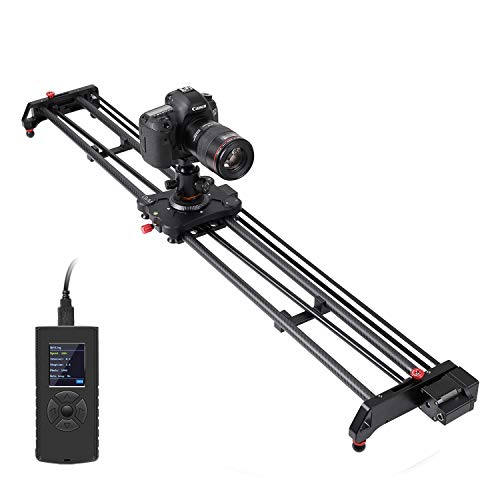
This GVM model emphasizes a carbon fiber build for strength and reduced weight, paired with remote control for convenient operation. It supports automatic round trips, time-lapse, and panoramic shooting up to 120°. The 48″ length offers ample travel for medium-length productions, while the adjustable tracking and speed parameters enable precise motion control. It is designed to work with a range of tripods and supports multiple mounting configurations to suit different shooting environments.
The remote control interface allows on-the-fly adjustments to time-lapse settings, slide distance, and loop behavior, helping operators capture repeatable sequences across takes. The robust construction and flexible mounting options make it a solid option for studio setups as well as on-location shoots requiring reliable, repeatable motion.
Buying Guide: Key Purchase Considerations
- Motion modes and programmability: Look for sliders offering time-lapse, video, tracking, and panoramic modes. Ensure you can set start/end points, speed, dwell time, and loop options to match your projects.
- Weight, load capacity, and balance: Align payload capacity with your camera system, including accessories. A carbon fiber or aluminum chassis can offer stiffness with reduced weight, improving stability on uneven ground.
- Control method: Options include app control, remote control, or built-in LCD screens. Consider whether you need wireless operation on location, and how easy it is to adjust settings mid-shoot.
- Power and runtime: Battery-powered models are ideal for on-location work. Check battery type (NP-F, rechargeable packs) and expected runtime, plus whether you can recharge during shoots.
- Mounting versatility: Ensure the slider has multiple 1/4″ and 3/8″ screw ports, compatible with tripods, ball heads, and other rigs. Vertical, horizontal, and angled shooting capabilities add flexibility.
- Camera compatibility: Verify compatibility with your camera size and accessories (handheld grips, external monitors, and microphones) and whether you need additional adapters.
- Build quality and noise level: A quiet, smooth drive reduces audio interference during video work. Carbon fiber and precision bearings help minimize jitter and audible motor noise.
- Portability and setup time: If you shoot on location, compact size, carrying case, and fast setup reduce on-site downtime and streamline production workflows.
Across these options, users should weigh how much motion control they need, how easy the system is to operate under field conditions, and how well it integrates with existing camera gear. For larger shoots with longer timelines, battery life and remote control flexibility can be decisive. For studio work, precision, repeatability, and build rigidity may take precedence. The right choice balances feature set with practical workflow requirements.