Best Camera Adapters for Telescopes: Optimize Prime Focus and Eyepiece Photography
Whether you’re chasing crisp lunar details or distant galaxies, the right camera adapter can unlock prime‑focus photography through a telescope. This guide highlights five reliable options that align with common camera types and shooting styles, from direct prime‑focus to eyepiece projection and smartphone capture. Each pick offers solid build quality, straightforward setup, and compatibility with a range of imaging gear. Explore how these adapters can streamline astrophotography and help you capture compelling night-sky imagery.
| Product | Camera / Scope Compatibility | Best For |
|---|---|---|
| Starboosa Variable Extension Telescope Camera Adapter (Canon) | Canon SLR/DSLR (not suitable for most mirrorless) | Prime‑focus and eyepiece projection for Canon bodies |
| Celestron Smartphone Adapter for Telescope | Smartphones (iPhone, Galaxy, Pixel) on any eyepiece | Imaging/video through any optical tube or spotting scope |
| SVBONY T2 T Ring Adapter (Canon EF) | Canon EOS DSLR / SLR | Direct prime‑focus photography |
| Starboosa Telescope Camera Adapter (Nikon) | Nikon SLR/DSLR (various models) | Prime‑focus photography and eyepiece projection |
| Celestron 93633‑A T‑Adapter | SLR/DSLR to Schmidt‑Cassegrain telescopes | Prime focus with legacy SCT setups |
Starboosa Canon Extension Adapter

The Starboosa Variable Extension Telescope Camera Adapter for Canon SLR and DSLR cameras connects the camera body to a telescope for both prime‑focus and eyepiece projection photography. It features a T2 ring interface, making it compatible with Canon EF and related bodies. The design emphasizes ease of use and extendability, allowing photographers to adjust the effective focal length by sliding the extension tube. Note that mirrorless bodies are generally not suitable for this setup, reinforcing its focus on traditional Canon DSLRs and SLRs. Eyepieces can be integrated inside the extension for enhanced detail, which helps achieve sharper planetary and deep‑sky imagery.
Key considerations include alignment stability, the range of extension offered, and how well it integrates with your existing telescope—particularly if you plan to preserve eyepiece viewing alongside imaging. The kit is positioned as an essential astrophotography accessory for enthusiasts pursuing both prime‑focus and eyepiece projection techniques with Canon cameras.
Celestron Smartphone Adapter for Telescope

The Celestron Smartphone Adapter enables capturing images and video through a telescope, binoculars, spotting scopes, or even a microscope by mounting a phone over the eyepiece. It’s designed as a universal, durable option with a metal body for longevity and a compact footprint for travel. The adapter is straightforward to use: place the phone in the holder, center the camera over the eyepiece, and tighten the knobs to secure it. It supports a wide range of smartphones, including models with protective cases, which makes it a versatile choice for quick digiscoping and outreach photography without the need for heavy, dedicated camera gear.
Considerations include phone model compatibility, alignment stability during windy nights, and the impact of eyepiece diameter on fit. For beginners or casual observers, this adapter offers an approachable bridge between visual observing and digital sharing of night skies.
SVBONY T2 Ring Adapter for Canon EF
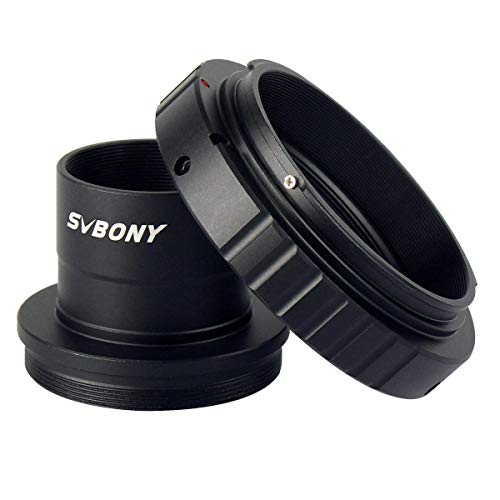
The SVBONY T2 Ring Adapter offers compatibility with Canon EOS EF lenses and standard 1.25″ telescope interfaces, enabling straightforward direct connection between a DSLR and telescope for prime‑focus photography. It is noted as easy to use, guiding users through the sequence of attaching the T‑ring to the camera, then threading the adapter into the telescope’s T‑thread. The product emphasizes broad compatibility with common 1.25″ accessories and cameras, though it does not fit EOS‑M mirrorless models. This makes it a solid option for Canon shooters prioritizing reliable, minimal‑friction imaging with established prime‑focus workflows.
Installation considerations include ensuring the proper T‑ring is chosen for your Canon body, aligning camera orientation to avoid vignetting, and validating telescope back focus for sharp stars and planetary details.
Starboosa Nikon Telescope Camera Adapter

This Starboosa Nikon camera adapter provides a variable extendable platform to connect Nikon SLR/DSLR bodies to a telescope via a T2 ring. It mirrors the Canon version in structure, supporting prime‑focus and eyepiece projection techniques. The product states compatibility with a broad spectrum of Nikon DSLRs and reflects the common constraint: mirrorless bodies are generally not suitable. The adapter’s design aims to simplify coupling a camera body with a telescope, enabling more precise control over focal length via extension. As with other long‑exposure astrophotography setups, stability and accurate alignment are crucial for best results.
Photographers should assess whether a given Nikon body requires additional spacing or back focus adjustments specific to their telescope model, particularly when combining with eyepieces or Barlow elements for higher magnification.
Celestron 93633‑A T‑Adapter

The Celestron 93633‑A T‑Adapter is designed to fit SLR or DSLR cameras to Schmidt‑Cassegrain telescopes for prime‑focus imaging. It threads onto the rear cell of the telescope, providing a standard T‑thread interface that accepts a corresponding T‑ring (sold separately). This adapter is a staple for SCT users who want a reliable, straightforward path to prime‑focus photography without additional mounts or complex alignment steps. It’s especially compatible with classic SCT setups and a broad range of camera brands through their respective T‑rings, making it a versatile backbone for long‑term astrophotography projects.
Considerations include compatibility with your specific SCT model, availability of the correct T‑ring for your camera, and whether your back focus needs adjustments to optimize planetary vs. deep‑sky framing. This adapter is part of a stable, time‑tested imaging chain for dedicated telescope users.
Buying Guide: Key Purchase Considerations
- Camera compatibility: Identify whether your camera is DSLR, mirrorless, or a smartphone. Many adapters are model‑specific (Canon EF, Nikon F, etc.) or universal (T‑thread) but may exclude mirrorless bodies without an adapter.
- Imaging approach: Decide between prime‑focus, eyepiece projection, or digiscoping. Prime‑focus tends to yield the cleanest star fields, while eyepiece projection can boost magnification but requires careful alignment to maintain edge sharpness.
- Back focus and spacing: Back‑focus distance matters for sharpness at the edges of the frame. Extension tubes and T‑rings alter spacing; verify compatibility with your telescope’s design and focal length.
- Eyepiece compatibility: If you plan to use eyepiece projection, confirm that the adapter’s extension tube accommodates the eyepiece diameter and that a secure seal is achieved to avoid light leaks during exposure.
- Build quality and durability: Metal construction (aluminum or alloy) generally offers greater stability and longevity, which helps reduce vibration during longer exposures.
- Portability and travel readiness: For field work, consider compact, travel‑friendly adapters with simple setup to maximize observing time in the field.
- Ease of use for beginners: Smartphone adapters provide an approachable path into astrophotography, allowing you to prototype, share, and build skills before investing in heavier imaging gear.
- Future expansion: Choose adapters that can be integrated with additional accessories (guiders, focal reducers, or field flatteners) as your imaging ambitions grow.
- Cost versus value: While higher‑end adapters offer precise tolerances, many users find reliable results with well‑built, mid‑range options, especially when starting out.
In sum, selecting the best camera adapter for your telescope depends on your camera format, your preferred imaging style, and how much you value simplicity versus flexibility. The options above cover Prime‑Focus and Eyepiece Projection pathways across Canon, Nikon, and smartphone ecosystems, with multi‑brand support through standard T‑thread interfaces. When you pair a compatible adapter with a stable tripod or mount and a well‑calibrated telescope, you gain a practical route to enjoy crisp celestial imagery and meaningful astrophotography experiments.