Best APS-C Wide Angle Lenses for Sony E-Mount Cameras
Discover top wide-angle options for APS-C mirrorless systems, focusing on sharp edges, fast apertures, and reliable autofocus. This guide highlights five standout choices that fit Sony E-mount APS-C bodies, helping photographers capture expansive landscapes, architectural interiors, and immersive vlogs with ease.
| Product | Brand | Focal Length / Aperture | Key Benefit |
|---|---|---|---|
| VILTROX 15mm F1.7 | VILTROX | 15mm F1.7 | Very wide field of view with bright background blur |
| VILTROX 9mm F2.8 | VILTROX | 9mm F2.8 | Ultra-wide perspective for expansive scenes |
| Sony E 11mm F1.8 | Sony | 11mm F1.8 | Compact, fast, versatile for vlogs and interiors |
| VILTROX 9mm F2.8 E | VILTROX | 9mm F2.8 | High-angle, dramatic landscapes with close focusing |
| TTArtisan 10mm F2.0 | TTARTISAN | 10mm F2.0 | Bright, sharp, affordable ultra-wide for APS-C |
VILTROX 15mm F1.7 E-Mount Lens
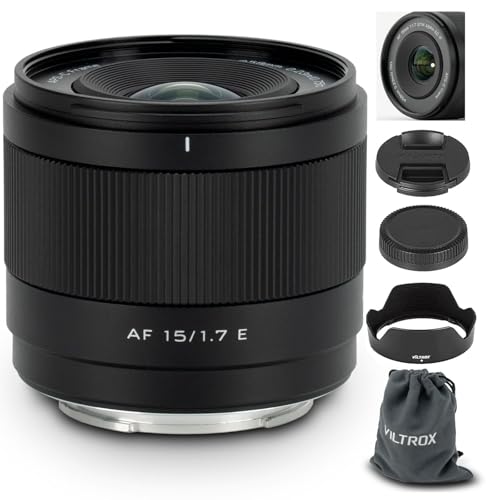
The VILTROX 15mm F1.7 provides an 84.9-degree wide angle suitable for landscapes, architecture, and interior photography. Its large F1.7 aperture enables shallow depth of field for selective subject focus while maintaining expansive scene coverage. Autofocus is guided by an STM motor for smooth and accurate tracking, making it practical for portraits, moving subjects, and video work in varied lighting conditions. The compact design suits Sony E-mount APS-C bodies without compromising handling or balance during shooting.
VILTROX 9mm F2.8 E-Mount APS-C Lens

This ultrawide 9mm lens delivers a 113.8-degree field of view, ideal for dramatic landscapes, interior shots, and dynamic vlogs. With a bright F2.8 aperture, it handles low-light environments better and enables slower shutter speeds for creative effects. A minimum focusing distance of 0.13 meters allows you to emphasize dramatic foregrounds and create striking depth in tight spaces, while maintaining broad context in every frame.
Sony E 11mm F1.8 APS-C Ultra-Wide-Angle Prime

This compact, lightweight APS-C prime provides dynamic perspective with a large F1.8 aperture. Its internal focus keeps length constant, aiding balance and handling. The 11mm field of view is well-suited for sweeping landscapes, comprehensive interiors, and engaging vlogging viewpoints, all while delivering consistent sharpness from center to edge across both stills and video work.
VILTROX 9mm F2.8 E, AF for Sony E

Featuring a 113.8-degree ultra-wide field of view, this lens suits expansive landscapes and dynamic vlogging. Its optical design includes multiple refractive and low-dispersion elements to maintain edge-to-edge sharpness. A 0.13-meter minimum focusing distance supports dramatic close-ups with strong foreground-background separation, while the autofocus system helps photographers lock onto subjects quickly in fast-paced shoots.
TTartisan 10mm F2.0 Ultra-Wide Angle

The TTArtisan 10mm F2.0 offers a bright, wide aperture for an APS-C system, delivering strong low-light performance and an expansive field of view. It features an HD multilayer coating to minimize flare and ghosting, ensuring high-contrast, vibrant images. Its optical design emphasizes sharpness across the frame and a close focusing distance that supports creative macro-like compositions within wide scenes.
Buying Guide
When choosing an APS-C wide-angle lens for Sony E-mount, consider these purchase factors to align with your needs and shooting style:
- Focal length and angle of view: Wider angles (9–15mm) emphasize scenery and architecture, while 11mm–25mm options balance environment and subject context. Decide how much background you want in frame and the level of distortion you can tolerate for your projects.
- Aperture and low-light performance: Brighter apertures (F1.7–F2.0) help in dim environments and enable more subject separation. If you shoot indoors or at night, a faster lens may be advantageous.
- Autofocus versus manual focus: Autofocus is convenient for video and fast-moving subjects. Manual focus can offer precise control for landscapes or fine art photography where depth of field is critical.
- Optical quality and distortion: Check edge-to-edge sharpness and distortion control. Some ultra-wide lenses exhibit noticeable barrel distortion; post-processing can help, but better optics reduce reliance on correction.
- Weight, size, and balance: Heavier or bulkier lenses can affect handling on smaller bodies. If you travel or shoot handheld for long periods, a compact option may be preferable.
- Build quality and reliability: Weather sealing and sturdy construction are worth considering for outdoor or travel use. Lens coatings also impact flare resistance in bright scenes.
Compared to standard APS-C lenses, wide-angle options require awareness of perspective and perspective-induced challenges, such as distortion and parallax in close-up interiors. The lenses listed here cover a range of budgets and features, from compact Sony-native designs to third-party options offering fast apertures and broad fields of view, enabling versatile shooting across landscapes, architecture, interiors, and vlogging contexts.