Best 14mm Wide Angle Lens: Top Picks for Vast Landscapes and Architecture
Answering you clearly: these 14mm wide angle lenses maximize scene width and perspective for landscapes, architecture, astrophotography, and creative interiors. They’re ideal for photographers who want expansive angles, minimal distortion, and strong edge-to-edge sharpness. Best fits include landscape shooters, real estate photographers, and astrophotographers seeking dramatic foregrounds. The following selections balance image quality, price, and compatibility across Canon, Sony, and Nikon ecosystems.
Below is a quick reference table for the five highlighted lenses, including brand, mount, and key strengths. This helps you compare at a glance before diving into each product detail.
| Product | Brand | Mount/Camera | Best For | Why Pick |
|---|---|---|---|---|
| Rokinon FE14M-C | Rokinon | Canon EF | Canon shooters needing f/2.8 and sharp wide frames | Strong corner-to-corner sharpness, fast aperture |
| VILTROX 14mm f4.0 FE | VILTROX | Sony E | Sony full-frame users | Excellent optical design with HR/ED elements |
| Samyang 14mm F2.8 for Sony E | Samyang | Sony E | All-around Sony users seeking built-in AE chip | Built-in metering with sharp, wide view |
| VILTROX 14mm F4.0 FE | VILTROX | Sony E | Budget-conscious Sony shooters | 112° view with close focus option |
| Samyang 14mm F2.8 for Canon | Samyang | Canon EF | Canon users needing low distortion | Hybrid optics with sharp results and built-in chip |
Rokinon FE14M-C 14mm F2.8 Ultra Wide Lens for Canon
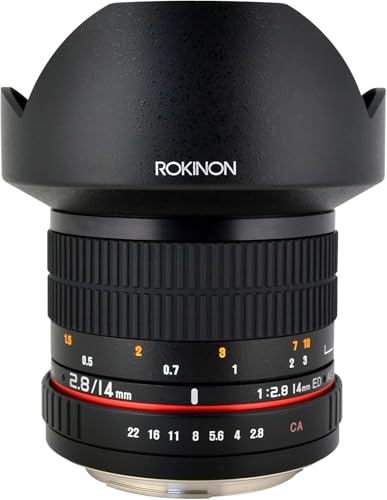
Key features: 14 elements in 10 groups deliver sharpness across the entire frame; 14mm focal length provides a 115.7° angle of view; fast f/2.8 aperture supports low-light shooting. Best for landscape and astrophotography on Canon EF mount. Choose this if you want a bright, wide view and strong edge-to-edge performance for large scenes.
Who it’s best for: Canon shooters who need a bright, ultra-wide prime for landscapes, real estate interiors, and night skies. Why selected: offers exceptional optical distribution with a wide field and reliable performance in dim lighting.
Caution: As an older design, consider checking for any vignetting at extreme corners with certain filters or adapters.
VILTROX 14mm f4.0 FE, AF for Sony E

Key features: 112° full-frame field of view; 12-element design with HR and ED elements to reduce aberrations; minimum focusing distance of 0.13m for close-up shots. Best for Sony full-frame shooters who want a compact, lightweight option with solid image quality and autofocus. Choose this if you’re building a budget or travel-friendly Sony wide-angle kit.
Who it’s best for: Sony shooters seeking a sharp, affordable wide-angle option with reliable AF and broad perspective. Why selected: strong optical design for architectural, landscape, and interior photography in a Sony E-mount package.
Caution: F4.0 aperture can limit performance in very low light compared to faster primes; plan for some ISO adjustments in dim scenes.
VILTROX 14mm F4.0 FE-Mount for Sony
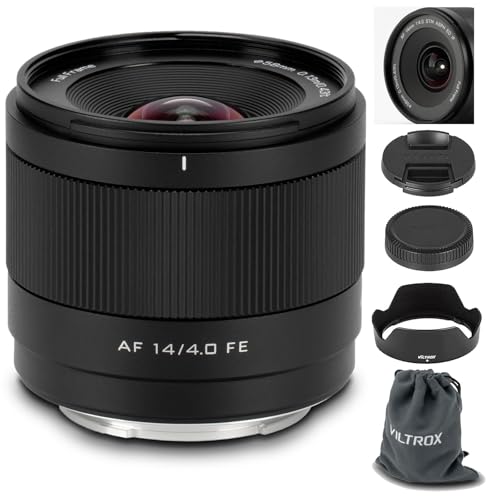
Key features: 112° ultra-wide angle; 0.13m minimum focus distance enables dramatic foregrounds with near subjects; eye/face AF helps keep subjects sharp during handheld shooting or vlogging. Best for Sony users who want a wide, reliable lens with modern autofocus features. Choose this if you need quick focus on close-in compositions and broad landscapes.
Who it’s best for: Vloggers and landscape shooters on Sony who value autofocus and a wide field of view. Why selected: combines a generous angle with modern autofocus and close-focus capability for versatile shooting.
Caution: Autofocus performance varies in very low light; pre-focus or manual override may be necessary in such cases.
Rokinon 14mm F2.8 AF Wide Angle for Sony E

Key features: Internal focusing; ergonomic design; focuses to 7.9 inches. Best for Sony users who want autofocus and easy handling in a compact form. Choose this if you prefer a Sony AF option with a practical minimum focus for creative close-ups and wide scenes.
Who it’s best for: Sony E-mount photographers seeking autofocus convenience and a compact ultra-wide option. Why selected: reliable autofocus with close-focusing capability for expressive compositions.
Caution: As with many wide-angle lenses, distortion control is important; plan to correct perspective in post if critical geometry is required.
Rokinon 14mm f/2.8 for Nikon F

Key features: Fixed focal length of 14mm; minimum focusing distance of 10.8 inches; non-zoom design. Best for Nikon F-mount users who want a dedicated ultra-wide prime with minimal complexity. Choose this if you shoot Nikon full-frame and want classic manual focus performance with good image quality.
Who it’s best for: Nikon shooters who prefer a dedicated 14mm prime with straightforward operation. Why selected: simple, reliable ultra-wide option for architectural and landscape work.
Caution: No built-in motor; manual focus only in some versions—check your body compatibility for AF capabilities.
Samyang 14mm F2.8 Canon / Built-In AE Chip

Key features: Hybrid aspherical and ultra multi-coated elements; built-in AE chip for Canon; approximately 115° angle of view; low distortion. Best for Canon users who want an easy exposure experience with accurate metering. Choose this if you need seamless Canon compatibility and a wide field without heavy distortion.
Who it’s best for: Canon shooters who want a wide, sharp lens with automatic exposure control. Why selected: built-in metering chip ensures consistent exposure across scenes.
Caution: Manual focus may be preferred for critical macro-like landscapes; ensure focusing precision for best results.
Buying Guide: 14mm Wide Angle Lens Essentials
- Mount and compatibility: Confirm your camera brand (Canon, Sony, Nikon) and whether you need autofocus or manual focus. Some lenses include built-in AE chips for metering on Canon; others rely on camera AF systems.
- Aperture and light: Faster apertures (e.g., f/2.8) help in low light and astro photography but often come with heavier weight and potential distortion controls. Slower f/4.0 options save weight and cost but require higher ISO in dim scenes.
- Distortion and edge sharpness: Ultra-wide lenses can exhibit barrel distortion; look for designs with aspherical elements and ED/HR glass to minimize aberrations and distortion across the frame.
- Minimum focusing distance: Short distances (0.13 m to 0.20 m) enable dramatic compositions with prominent foregrounds, especially in architecture and interiors.
- Autofocus vs manual focus: Decide if you need quick AF for moving subjects or prefer manual control for precise composition and star photography.
- Weight and handling: Consider the lens’s weight and size for long shooting sessions, tripod stability, and travel practicality.
- Build and weather sealing: For outdoor landscape or astrophotography, weather sealing can be valuable, especially in challenging environments.
Quick comparison in bullets
- Best for Canon EF: Rokinon FE14M-C — bright f/2.8, strong wide view, good for night skies.
- Better for Sony E with AF: Samyang/Silver-line options — AF aids casual shooting and fast composition work.
- Budget-friendly Sony option: VILTROX 14mm f4.0 FE — solid optical design, autofocus, lighter weight.
- Best all-round architecture focus: Samyang 14mm F2.8 Canon/Nikon — built-in AE chip on Canon variant; sharp across frame.
Frequently Asked Questions
- What is the field of view of a 14mm lens? Typically around 112° to 115° on full-frame sensors, providing expansive perspective for landscapes and interiors.
- Do these lenses require filters? Many ultra-wide primes can accept filters, but some rear-filter or ultra-wide designs may have limitations; check seller specifications for your model.
- Is autofocus important on a 14mm lens? AF helps with moving subjects and video; for astrophotography or landscapes, manual focus often yields precise results.
- Which mount is best for beginners? Sony E and Canon EF variants are common and have broad accessory ecosystems; choose based on your camera body and workflow.
- Are 14mm lenses distortion-heavy? Some distortion is common; modern designs use aspherical and ED elements to minimize it, and post-processing can correct remaining distortion.
- How do I choose between f/2.8 and f/4.0? f/2.8 offers brighter performance in low light and shallower depth of field, while f/4.0 is lighter, cheaper, and adequate for many landscapes.