Best 100mm F/2.8 Macro Lenses for Canon, Sony, and More
Macro photography thrives with a dedicated 100mm f/2.8 macro lens. This guide highlights top 100mm f/2.8 macro lenses across Canon, Sony, and third-party options, focusing on reach, image clarity, and ease of use for detail-rich close-ups. The selections below balance native and third-party choices to suit various camera systems and budgets.
| Product | Mount / Type | Key Feature |
|---|---|---|
| Canon RF100mm F2.8 L Macro IS USM Lens | RF Mount, Medium Telephoto Macro | Up to 1.4x magnification, optical image stabilization up to 5 stops |
| Laowa 100mm f/2.8 2X Ultra Macro APO | Full-frame for Sony E | 2x magnification, APO optics |
| TTArtisan 100mm f/2.8 Macro (Canon RF Mount) | RF Mount, Manual Focus | 2x magnification, 12-blade aperture for smooth bokeh |
| Canon EF 100mm f/2.8L IS USM Macro (Renewed) | EF Mount | Fixed f/2.8, IS, 1:2.8 macro, robust build |
| TTArtisan 100mm f/2.8 Macro for F-Mount | F-Mount, Manual Focus | 2x magnification, strong micro-contrast |
Canon RF100mm F2.8 L Macro IS USM Lens

The Canon RF100mm F2.8 L Macro IS USM delivers a true macro experience with a 1.4x maximum magnification and a fixed bright f/2.8 aperture. Designed for EOS R series mirrorless cameras, it combines high image quality with a medium-telephoto perspective that flatters close-ups of small subjects. Optical Image Stabilizer provides up to 5 stops of shake correction to help handheld macro work in varied lighting.
Canon EF 100mm f/2.8L IS USM Macro Lens (Renewed)

This EF-mount macro lens provides a classic 100mm focal length with a maximum aperture of f/2.8. It features Image Stabilization and a robust USM for fast AF, making it suitable for close-up portraits, nature details, and product photography with Canon DSLR bodies. Note that extenders and some close-up add-ons are not compatible with all configurations.
Laowa 100mm f/2.8 2X Ultra Macro APO

Laowa’s 100mm f/2.8 2X Ultra Macro APO is designed for macro work with APO optics to reduce chromatic aberrations. It supports high-magnification close-ups and is compatible with Sony E-mount bodies. Its 12-element-in-10-group construction emphasizes sharpness across the frame, making it a strong alternative to native Canon macro options for compatible cameras.
TTArtisan 100mm f/2.8 Macro (Canon RF Mount)
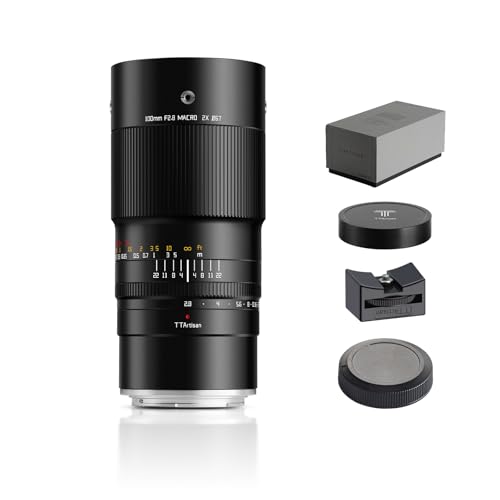
This manual-focus macro lens delivers 2x magnification with a bright f/2.8 aperture and a 12-blade blade structure for smooth bokeh. It also features a cold shoe expansion hub that enables creative accessory setups, such as ring lights or external mics. It is a budget-friendly option for Canon RF mirrorless cameras seeking macro capability without autofocus.
TTArtisan 100mm F2.8 2X Macro for F-Mount

For Nikon- and other F-mount compatible bodies, TTArtisan offers a 2x macro option with manual focus. The design emphasizes a compact form, strong macro reproduction, and a 12-blade aperture for refined background blur. This choice suits users seeking a dedicated macro lens in a budget-friendly tier for F-mount cameras.
Buying Guide
Important considerations when choosing a 100mm macro lens include mounting system, autofocus vs. manual focus, magnification, and stabilization. Native macro lenses (like Canon RF and EF variants) typically deliver seamless autofocus performance and optimized optical designs for their camera systems, along with reliable in-body or lens-based stabilization. Third-party options offer price advantages and cross-system compatibility but may rely on manual focus or require adapters for full functionality.
Key purchase considerations:
– Magnification and working distance: Most 100mm macro lenses achieve 1:1 or close to 2x magnification. Consider the working distance you need for delicate subjects.
– Autofocus vs. manual focus: For fast-moving subjects or hands-free work, autofocus can be beneficial. Manual focus often yields precise control for micro-details and still-life subjects.
– Stabilization: Image stabilization helps in handheld macro shots. Some lenses include IS, while others rely on camera bodies or require steady support.
– Image quality and distortion: APO and high-quality glass minimize chromatic aberration and edge softness. Check for flat-field performance across the frame.
– System compatibility: Native lenses integrate more smoothly with camera bodies, but third-party options can offer compelling value across multiple mounts.
Comparison snapshot:
– Native Canon RF/EF macro lenses typically deliver robust autofocus, weather sealing, and optimized color rendering within their ecosystems.
– Laowa and TTArtisan options emphasize high magnification and creative features like expansion hubs or strong bokeh, often at lower prices, but may require manual focus or adapters.
– For Sony E or F-mount users, third-party macro lenses can fill gaps without changing camera systems, though autofocus behavior and support can vary by model.
Selecting the right macro lens depends on your camera system, desired magnification, and how much you prioritize autofocus, stabilization, and budget. Always verify compatibility with your specific camera body and firmware to ensure full functionality, especially for older DSLRs and newer mirrorless systems.